2025
This world wasn’t built for me. Sometimes, I don’t think it was built for anyone or anything real. It was built for some artificial figment of objective human ideology, Not for real, feeling creatures. What would the world look like if it had been built for us?
The Alchemist’s Laboratory
Whisper into the void with me: https://rainbowafterdark.micro.blog
Podcast is on an indefinite hiatus There may be future episodes, there may not! Thank you for listening!
Note: This episode includes emotionally vulnerable reflections on trauma, spiritual disillusionment, and the ongoing process of healing. While not graphic, the tone is raw and candid, including moments of frustration and tenderness. Please listen with care, especially if you are in a sensitive emotional state. As always, take what serves you and leave the rest.
In this tender episode of Rainbow After Dark, I invite you into the heart of my inner process—where emotion, intuition, and discernment meet in real time. I’ll share from the raw edge of my own sensitivity, and speak on what it means to feel deeply in a world that often rewards disconnection. With a nervous system shaped by trauma and a healing path rooted in embodiment and self-trust, we’ll explore the slow, courageous work of emotional alchemy: metabolizing emotion into wisdom without bypassing or self-abandonment.
Together, let’s challenge the polished narratives of mainstream spirituality. I offer a compassionate critique of ideas like “high vs. low vibrational emotions,” affirming instead that all feelings are inherently worthy of presence. To quote myself: “There’s no such thing as a low or high vibrational emotion, okay? I will die on this hill.”
This was recorded in a moment of real-time vulnerability, and The Alchemist’s Laboratory is more than a conversation—it’s a lived example. In a nuanced return to my own intuition, I’ll model how to stay with what’s real, even when it’s messy or uncomfortable.
This is an offering to those who feel deeply, who question spiritual shortcuts, and who are learning—again and again—that their sensitivity is not a flaw but a compass.
Thanks for listening to Rainbow After Dark! If you enjoyed this episode, be sure to subscribe so you don’t miss future ones. If something resonated with you, I’d love to hear your thoughts—feel free to leave a comment here, or on YouTube (I don’t use it much, but I exist!).
This podcast is a space for reflection and exploration—it is not a substitute for professional advice. Please take care of yourself and seek support as needed.
———
Transcript for Episode 8: “The Alchemist’s Laboratory”: Hello, hello.
If you don’t know, I’m Rainbow, and this is Rainbow After Dark.
And this is the third time I’ve tried to record this episode. Not because I’m trying to make it perfect, but because the first time I screwed up the audio. I was working in a different way than I have done the other episodes—the other episodes in the past—and I, yeah… I ended up screwing up the original audio file and I couldn’t fix it and I wasn’t about to release it the way that I could release it so I recorded it again, and… it was… fine… but it didn’t feel right. And while I am done holding myself to some sort of unachievable and, like, unrealistic standard, I have really had to come face to face with my perfectionistic tendencies, especially in recent years. Because of what I want to talk about in this episode, it felt really important for me to do it in a way that felt right to me.
So, third time’s a charm.
We’re doing this again. If you’re listening in, welcome. It’s good to have you here.
Yeah. Let’s get into it.
So, today, what are we talking about?
I want to talk about alchemy. Not in the practical sense—you know, turning lead to gold—but more in an emotional sense. I wanna talk about emotional alchemy, our intuition, and the philosophy of becoming. So if that sounds good to you, please stick around. Let me know your thoughts if you listen to the episode, I would love to hear how this lands for you.
So, what is alchemy? Alchemy is a transmutation process, right? It’s taking something and turning it into something else. It is generally considered, like, you have to have an equivalent exchange, right? If you’ve seen Fullmetal Alchemist you know they talk about this. It’s a whole fantasy perspective of it, but it still kind of applies here, right? You have to have something that you want to understand and break down and turn into something else. So what does that mean for emotional alchemy?And quite simply, it’s utilizing your emotions as fuel. However, I feel like the way we get taught to do this—if we get taught to do this at all—is a whole freaking mess.
Emotions are a big thing for me. Emotions, in some ways, are everything. We as humans are emotional. We are our emotions, and that’s not something that people like to think about especially because so many emotions are shamed and demonized. We’re taught to avoid them, to bypass them, to compartmentalize them, to cut ourselves off from our sense of being. Some people say emotions are energy in motion, and so, if we as human beings are essentially energy in motion, we are emotions. We are our emotions. And that doesn’t meant that you have to wholly identify with being the emotion. Like, you aren’t, you know, just anger or sorrow or whatever it is, right? But those feelings… they catalyze you to propel forward. There is nothing that you would achieve without utilizing the underlying emotions.
Now, the way we do this—energy—emotions are not problems to solve, okay? They’re not something to fix and they are not something to change. I feel like one of the things that we talk about a lot when it comes to emotions is: don’t be, you know, controlled by your emotions, and you can change, and you can control how you feel, blah blah blah blah, and like… okay, I get it. Some emotions are uncomfortable, but none of them are worthless, none of them are inherently harmful, and the problem is that we’re taught that that’s true. Or we see people who harness emotions in ways that are harmful, that are detrimental. So we learn that. And then we learn that we have to fix our feelings.
But feelings are just feelings. That’s what they are. They are feelings and they are giving you information.
Everything is information.
Feelings are no exception. Feelings, emotions… they are sacred, okay? They are important. They are messengers. They are wisdom. They are here to inform you about your present experiences and/or your previous experiences and how your present experience might be reflecting or echoing those previous experiences and what you need to be present with and understand about yourself and those experiences in order to move forward in alignment.
I feel like, especially when it comes to the spiritual communities—spiritual field—there is a lot of demonization of emotions. There’s a lot of bypassing that is encouraged when it comes to emotions, suggesting that, well, if your, you know, natural state is, you know, bliss or whatever then you can choose to not feel suffering and blah blah blah. Look. I get it. I do. I get that there are certain emotions that are uncomfortable and I feel like part of the reason that we feel so uncomfortable with them is because we don’t know how to be present with them.
There’s no such thing as a low or high vibrational emotion, okay? I will die on this hill—I will die on this hill. There’s no such thing. There is only your wholeness. Your full spectrum of experience. And that includes every emotion.
Your anger comes up because it is showing you where your hurt is, what you’re protective of, where you need to set boundaries and make requests of people. It’s important and it loves you.
Your grief shows you what you have loved, what you care about, what is important to you in a different flavor. ‘Cause here’s the thing—you’re gonna hear me repeat a lot of this—emotions are just different flavors of the energy, okay?
They’re different flavors. They’re different textures. Different sights and scents or however you wanna put it.
But ultimately, all of them carry a kernel of truth for you about your experience and what is important to you as the person you’re currently being right now—as the person who is inherent to you—who is natural to you.
Even our most rejected emotions, shame and fear—I feel like these are the two that people really, really don’t wanna feel—they are highly rejected. Fear especially. We are taught—I’ve talked about fear in past episodes—and fear is one where we are often taught to overcome fear, and to fight fear, and fear is the enemy, and all this kind of stuff.
No.
I highly disagree with this in like, a massive way.
Because through my process, this whole entire process of returning to myself, what has done the most good for me—what has helped me more than anything—has been befriending my fear. Sitting with and being present with y fear. It doesn’t mean that I have to let it control the actions that I take, the things that I do… it means listening. Stopping. Being present with it. What do you have to tell me? Because fear is not your enemy. Fear is not trying to stop you. Fear is the great illuminator. It shows you what you truly love and care about if you can untangle the web of conditioning and distortion that is held around it.
The same with shame. Shame teaches us compassion. You can’t shame somebody—you can try, okay? People do this all the time. We as a culture, we try to shame people for things that they do, that we feel are not okay, right? But shame is an inside job—inside job—shame is an inside job, and shame needs to be felt. Because shame, more than anything, shows you where you are not in alignment with your truth—where you are not in integrity with yourself—where you are incoherent. And it tends to be wrapped up in all sorts of conditioning because there are aspects of our culture that try to promote and instill shame into us about certain behaviors and, you know, certain ways of being. And it’s not an easy thing to untangle that. And I am not here to tell you that it is an easy process because all of this—it involves shedding layers and layers and layers of distortion and conditioning about who you think you are, who you thought you were, who you had to become in order to survive. And I don’t simply mean survival in the way of, you know, you need oxygen and you need food and you need water and that kind of thing; like, the very basic physical survival components. Because while those are extremely important, it goes beyond that. We as humans are wired for connection, and so, in order to survive in community with other humans, there are certain roles that we take on in order to keep ourselves safe. And we’re not wrong. We are not wrong for embodying these roles. However, they will always keep us stuck in boxes. And if we really want to flourish, if we really want to thrive—we get to figure out how to create better systems not just for ourselves but hopefully as humanity.
You know, ideally, it wouldn’t be this… quite this much of a task for us. We’d be—we’d be taught how to sit with our emotions. We’d be taught how to communicate how we feel and what we need in ways that don’t feel so threatening, that don’t feel so manipulative, that don’t feel misaligned with our integrity and with our fullness.
Being present and embodied is so important, and if you are bypassing and over intellectualizing what you feel, you’re going to stay stuck, and I don’t say this to shame you. I’m not telling you you’re doing it wrong—you’re in process, and that’s important. We can’t transform if we’re suppressing what we need to experience. So emotional sovereignty, emotional embodiment—full embodiment and acceptance of our experiences and the way we feel about those experiences—is key. And acceptance doesn’t mean that you’re okay with it necessarily; it means honoring and acknowledging what is. What is currently occurring in this present moment, or what you have felt about past experiences that might still need to be felt. ‘Cause just ‘cause it happened, you know, 30 years ago, doesn’t mean that it’s gone. It’s gonna live in your body until you feel it and process it. And this is a hard truth that I’ve had to learn. This is not something—this is still—this still can be challenging for me, right? I’m not talking from a place where I’m like oh I’m full—I’m fully—I don’t think that fully healed is a thing, right? As humans we are constantly in process, that is, that is the thing, you know? Even for me right now.
I’m sitting here and I’m talking to essentially myself. I’m talking to myself and if you’re listening to this, talking to you, who is, in some ways… you’re me, and I’m you, right?
We’re connected, we’re part of all of it, and I’m just being here, sitting in the discomfort that I feel about talking about this. Because it feels like I’m breaking the rules. Like, this is something that is really, deeply embedded in my system—that I can’t speak out against the status quo, that I have to do everything perfectly, that I can’t make mistakes. Because how can somebody love me if I get it wrong? How can I be loved and accepted if I’m not getting it right? But if there is no way for me to “get it right”, then what does that mean? That terrifies me. Like, I’m sitting here and I am almost in tears because that’s scary for me… and I get to sit with that. I get to acknowledge that. But it is scary. And that little part of me—that tender little dewdrop—that has been taught that they need to be a specific way, and they had to contort themselves and compress themselves to be a specific thing, a specific way, a specific role—in order to survive, in order to be loved, in order to be cared about. They’re not wrong. That is what they’ve been taught through their experiences. And it makes sense for me to feel afraid.
And that’s okay. I’m still here. I’m still talking. I’m letting this energy flow and acknowledging the depth of it. That it is something that is scary. That it is something that’s not easy for me. This is challenging for me. And I still wanna do it. Because I feel like it’s important.
When I stopped trying to fix how I felt—when I stopped trying to change it—that’s when things started to shift. Not just emotionally, but physically, spiritually. That’s when I realized that this wasn’t just healing—this was alchemy. It is an alchemical process.
And if you want to really alchemize your experience as a human, the way to do that is through feeling.
I do feel like the way that we do this though—the way that a lot of people talk about it—is really complicated and it’s not, like, sometimes they make it seem like it’s just a one off thing where you just, like, you just decide to feel it and/or you decide to let it go or you detach or whatever. I’ve heard—I’ve heard a lot of things over the years, and there was a period of time where I was like “obviously these people know more than I do, they’re in better situations in their life it looks like, so they must know something I don’t know, maybe I’m just doing it wrong”. And I realized that a lot of the things that I heard people say about this… they didn’t feel right. They didn’t feel right to me in my body. And that’s because a lot of the rhetoric around this still encourages bypassing. It still promotes the idea that you need to feel differently than you presently are experiencing feeling, because of X, Y, and Z reason.
I get that.
There is certain emotions that are not as easy—that are much more challenging or uncomfortable or even painful to feel—than others. And all of them are important. All of them are valuable. All of them are parts of you that want you to welcome them home and then when you get all of them together you can have a little party and put party hats on everybody.
Just personify your emotions. It’s—it’s cool. That’s what started happening to me through this process—everybody started—all my emotions started kind of personifying themselves and they’d show up as these specific kind of energies.
This is weird for me to describe because I have what would be considered aphantasia. I cannot, like, voluntarily visualize the way that, apparently, a lot of people can. I didn’t even know that was a thing that was possible until several years ago and I had to go through an entire process of feeling like my brain was broken because I don’t see things the way other people do. This doesn’t mean I don’t have an imagination. It doesn’t mean that, you know, like, the way I visualize is just… it’s not visual. Which seems completely contradictory. However, it doesn’t change the fact that when I have interacted with a lot of my emotions, these energies—these archetypical energies that encompass emotions—they didn’t… personify themselves in a way that I could very much describe to you.
One of the most interesting ones for me was the personification of control. They came out as being, like, this very interesting, almost monstrous sort of creature. And it was like, when I first interacted with them as, like, that energy—they had almost like a mask of my face with this really, like, unnatural sort of grin and their hair was, like, pin straight. Which completely contrasts—my natural hair is pretty curly, you know—so it was like manipulated to be straight. And they had this really long body with like a million arms. It was just like a bunch of arms and hands. It was really weird and it really brought into focus how much control had been a part of my life. How much I had tried to control different things—often subversively—because I needed to be able to feel safe. And when I started understanding this energy, and this emotion, I could start to let things go and figure out what I actually had control over and focus on those things—focus on the things where I actually can control it.
So, I don’t know if this is something that most people do naturally or can do. I don’t know—I don’t know other people’s experiences with this sort of thing, right? I just know this is my experience with the thing. And at this point I’ve basically had—and it’s not something I voluntarily did, like, I feel like you could definitely do this voluntarily, where you feel an emotion come up and you want to work with it so you find a way to personify it, right? Like, with a conscious intention—and that could potentially be really helpful for some people. For me, though, it was like they came to me basically fully formed. When I started really focusing on emotional processing and nervous system regulation and things like that, they would essentially arrive to me like entities. Like, they were fully formed sort of creatures or versions of me or whatever the case may be for whatever specific flavor of emotion I was experiencing in the moment. And sometimes they’ll shift to a certain degree, depending on the experience and how I’m interacting with them. But—they—it’s not, ironically, it’s not something that I really control. It’s not something where I’m like “okay, I want to see my anger this way” or “I want to see my joy this way, specifically”. They just show up like that.
If this is something that you do or have an experience with or do consciously and intentionally—I would love to hear about this, because I’ve never really talked to anybody about this before and sometimes it makes me feel a little nuts. Because I do—it’s like—I have a relationship with these energies because of this, right? It’s not that I didn’t have a relationship with them before, but I have been able to fully integrate them and take them all as part of me—as being mine—as being in relationship to them because of this. And that’s not to say that you can’t do that if you don’t do this. This is just the way my experience has been and I did get to a certain point where I had interacted with, like, all of these kind of, base emotions that had a really strong pull on my energy and really affected the way that I was operating in the world. And at a certain point joy came around and was like “hey, everybody’s here, let’s have a party! Let’s stick party hats on everybody!” And, you know, like, some of them are wearing like three party hats. Like, it was a thing—it was genuinely really enjoyable for me and I have a much easier time, kind of, like, sitting in communion with the way that I feel at any given moment because of this. Because I’m like, okay, this is just a part of me that may be rejected or it needs to tell me something. There’s a message here. This is a guide. This is a guide, right? That wants to tell me something.
A lot of this relates to our intuition and intuition, I feel like, is something that’s very vaguely touched on, you know? We’re often told to listen to our intuition and to trust our intuition, but what does that actually mean? And it also completely ignores the fact that your trauma—your trauma responses can masquerade as intuition—and if we aren’t really, really discerning about what’s what… if we don’t know how different things feel, if we’re really disconnected from ourselves and our bodies… then this is basically impossible.
And I know this from my own experience as someone who was very severely disconnected from their boy for the majority of their life. I’ve had chronic pain for most of my life, I’ve had various chronic health issues for most of my life, I’ve dealt with chronic stress and trauma and I’ve dealt with severe dissociation. I sometimes think that I have been dissociated for most of my life. I wasn’t in my body—I wasn’t present in my body—I wasn’t able to be because I needed to be disconnected in order to survive, in order to survive. And I feel like this is something that our culture actively cultivates—we teach people, we encourage people, to be disconnected—to be disassociated. And it’s not an easy thing to choose to come home to your body and be in your body especially if you have trauma, especially if you have chronic pain, especially if you have all of these different circumstances that teach you that being in your body isn’t safe. And if you don’t have the resources—if you don’t have the support—if you, like, you can’t do that. And so I don’t blame people who aren’t able to do that or even don’t want to. And I also know that long term, if we continue to move forward with a culture that pushes this kind of disconnection, we are all going to suffer for it—we are already suffering for it. And choosing to be disconnected from yourself—if you feel like that’s a choice you’re making—then it’s important to, you know, I feel like it’s probably important to figure out why. What is it you need? What you might need access to in order to shift that. Because long term, your causing yourself harm and I’m not saying that you want tot be doing that—because I don’t believe any of us are—but the only ones who can really fully understand what it is that we need in order to shift out of that is us.
And part of that is our intuition, right?
Intuition is a felt sense of knowing—it is a quiet clarity that’s rooted in inner safety. Being able to be safe with ourselves. And if we’re rejecting our emotions—if we’re rejecting the way we feel or if we’re rejecting our experiences because of some perception or believe that tells us that we’re not allowed to see them the way we actually do—or that we’re wrong or bad or low vibrational or whatever the heck the case may be—sinful—I don’t know. I didn’t grow up in that kind of paradigm, but I know it’s a thing. Then we are not able to actually access the safety that we need—the inner safety we need—to actually get in touch with our intuition. To actually be in alignment with ourselves, and in our integrity, and to be coherent with ourselves.
Like I said, trauma can masquerade as intuition—but it will show up as urgency, it’ll show up as fear, it’ll show up as reactivity—and the difference is that intuition tends to be very calm, really. At least for me. It’s like, it’s neutral—nearly robotic. It is devoid of emotional charge. It is quiet. Sometimes completely inconvenient. You don’t always want to hear what intuition has to say, and it’s not from some sense of reason, right?
Logic comes from our brain, form our mind, whereas intuition, it is a body-based knowing. And how it works for different people, I’m sure is different. I know in my experience, when I was working to really cultivate and reconnect to my intuition, it was a really challenging process to learn how much my trauma had been mimicking what I thought was intuition and that it was a mind-based process. And they’re both important, right? Because both of them seek to protect us. But they come from different spaces, different places, and serve different purposes. Because your intuition is your soul compass—and if you are shrouded in layers of distortion and trauma you can’t really access this. At least, not consistently, not in an embodied kind of way. And that’s not to say that your trauma can’t be right—because they can also overlap. You can have trauma that will, like, kind of create a feedback loop with intuition and, it’s like, it’s accurate—it’s correct—but it’s still trauma-based, and that’s a whole other thing. It’s complicated and we live in a world that gaslights us. That teach—like I said—it teaches us to disconnect from our bodies, from our sense of feeling, our felt experience—and it’s really, really hard to learn how to trust yourself and to trust that very, very, very quiet little inner voice. That sensitive little part of you that’s just gonna whisper what your truth is when you’ve been gaslit all your life and are probably gaslighting yourself.
But there’s a big difference between feeling calm in knowing and panicked, and clarity versus chaos or confusion. Confusion is essentially, like, the embodiment of incoherence, which is why I often consider confusion to be its own form of clarity. It means I don’t have clarity about something—something is unclear—and that itself is a form of clarity because I may not know specifics, but I know something is incoherent. And in certain cases it—there’s confusion because, like, you don’t know something, right? You might just need more information. But there’s certain situations that the—it doesn’t matter how much information you get, you still feel like there’s confusion, and that’s really—that’s an important thing to note because that is literally you telling you that we—there’s something isn’t aligning here, something is incoherent here.
So in the world that we have, that disconnects us from ourselves, form our bodies, from our intuition—how do we actually reconnect and how that process is gonna be different for everybody. For me, a lot of it just started with being willing to sit with myself—to be in my body—and to feel whatever it was I was feeling, and listen to somatic markers, and work with my own energy. A lot of that was learning just, what did my intuition actually sound like and feel like to me. Because I learned that my intuition is always in my body, like deeper in my body, like heart level and below, often times in, like, my spleen. Whereas if it’s my mind, it’s gonna feel like it’s in my head. And my mind has lots of important information for me, but its job is not the same as intuition. And I actually went through a period where I was redoing this kind of reconnection and really getting in touch with the understanding that, oh, my intuition is very quiet and is, you know, very neutral, and so my mind started mimicking that. Like, it would literally give me information as if it were my intuition and the only way that, for a while, that I was able to discern the difference was by where I felt this information coming from. Did it feel like it was coming out of my head? Or did it feel like it was coming from, like, my gut? Because if it was coming from my head, it wasn’t my intuition. It was important to listen to and also to sometimes question, because sometimes it was just, like, my mind trying to rationalize things and it just figured out a way to communicate with me in a way that I would listen to. But that didn’t necessarily mean it was accurate or correct or what I needed to be doing. But it did mean that I needed—I got to open a dialogue with my mind, right? And communicate with it.
And it’s always really weird to talk about, like, parts of me as if they’re not me—as if they’re external of me or separate from me—‘cause they’re not. And I know they’re not. And it’s also a think where, like, to be in relationship with something, there is inherently some subtle separation. Not because there is inherent separation or real separation, but it’s like defining the edges so that you know where to work with the energies—the person, the place, the thing, the whatever.
I’ve even—as I’ve gotten more adept at working with this, one of the most interesting experiments that I did regarding, like, listening to my intuition, was what I sometimes refer to as the Stardew Valley mining experience—experiments. And if you’re not familiar with Stardew Valley, it is a farming simulator game. It’s a cute little, like, pixel art kind of… it’s a, you know, very calm kind of cozy little game. You get a farm and you can grow different plants and you can go fishing and you can mine and you get cute little cows and chickens and stuff. It’s like a really cute game. I’ve played it—I used to play it, like, a lot. A lot. I’ve played—I’ve played many many hours of Stardew Valley. And I was playing it more recently, I feel like this was maybe late last year, and I was doing, you know, some mining in the game and if you’re unfamiliar with the way that the mining system for Stardew Valley works, you basically—you obviously—you go into the mine and then you have—there’s different levels to the mine. And in order to move down a level in the mine you have to find a ladder. And the ladder is usually hidden in a rock somewhere and it’s totally random, right? It’s complete—it’s a completely random algorithm as part of the program, and generally, this means you have to just hit a bunch of rocks or bomb a bunch of rocks or whatever until you find the ladder. Unless you have ladders—or staircases, I guess it is—but the point is that I was doing this, right? And I was curious if I could get, like, an intuitive hit about the location of the ladder in this game. And if I really just sat and listened for it, I would get directions—and they weren’t specific—it wouldn’t be like go over and hit, like, this specific rock over here or something. It was very much just, like; left, right, up, down. And sometimes at first I’d be like… is this even right? But I would just—I would just follow whatever was coming up and I hit the rocks and it was always right. That was the weirdest part about it is that if I was really grounded and, like, in my body and really listening… it was right every single time. Even if it took me a while to get to the actual rock that had the ladder, it was right—it would be to the left or it would be down or whatever I was getting. It was really weird.
And I don’t really know how this works and so if somebody out there has, like, explanation for how something like this works, especially because, like, this is, you know, this is a random program in a video game—that somehow my intuition was able to pick up on and give me some degree of instruction and direction for. And I don’t know why it works. I just know it did, which has given me a lot more confidence in trusting it.
It’s still really challenging sometimes—it can still—I still question, you know, sometimes I get these hits and I’m just like, what? Why? But more often than not, if I listen to it, that’s the right move.
Even right now, you know, I’m sitting here—I’m questioning if I am off somehow… something about something I’m doing maybe doesn’t feel quite right, and I’m not sure why.
So maybe I need to put the phone down and stop.
So, I actually did stop recording after this. I recorded the bulk of everything that you just listened to yesterday, and I honestly considered just leaving the episode as it was, especially ‘cause it’s pretty long. But I decided that there were a few more things that I wanted to add, and so I’m gonna record that now, because, especially considering the fact that I literally in the middle I—well not, maybe not in the middle—but toward at the end of that episode, I felt something in my body that told me to stop and I listened to it and I stopped—it feels relevant to discuss discernment, even if just a little bit. Because discernment is the crystallization of this whole alchemical process. It’s turning insight into choice, it’s the alignment of your decisions with your intuition and your embodied experience. This is as opposed to having reactive decisions—subconscious choices—made for you, as opposed to intentional and embodied responses and choices.
Essentially, it’s the cultivation of free will. We talk about free will a lot and we often say “oh, well everybody has free will” and that kind of thing, and, to be honest, I don’t know how true that is. I feel like you can only really access free will if you are really, fully conscious and aware of what you are doing and why you are doing it. Otherwise you are just operating on subconscious programming. And I feel like this is really, like, apparent if you consider something like the Libet experiments—I believe it’s pronounced Libet—Benjamin Libet, he was a researcher in the 80s, he did these experiments where they found out that what people thought were conscious decisions they were making were already processes that they could track through the brain waves before the person apparently choosing to make the decision was aware. So it was already a body process that was in process before their mind knew it was a choice. So, you know, food for thought. This is something that i’ve thought about a lot. A lot, a lot. Even right now, am I consciously choosing to talk about what I’m talking about? Am I just a puppet on the strings? Or am I really aware of myself enough to fully make this choice? This decision right now to say these words?
And we’re gonna make mistakes.
You know, you get to be okay with making mistakes throughout the process of refining your discernment and reconnecting to yourself. And that can be really challenging, especially if you’re someone like me who has a history of perfectionism, and, you know, whatever your particular flavor—flavors of survival based adaptations are.
So it’s important to remember that discernment is about listening—really listening—to your body. Listening to your soul. And it’s not about getting it perfect.
There’s a lot of moments where discernment didn’t show up in some big, dramatic way—it was a quiet “no” in my chest or that weird kind of “off” feeling that I couldn’t explain. Even if everything seemed fine on the surface. Sometimes, it’s meant stepping away from relationships that might have made sense on paper, but they didn’t feel right in my body. It’s about not contorting myself to be digestible, and letting go of things that sometimes I wanted to work—sometimes, I wanted them to work really, really, really badly—but they might not have felt right for some reason. It can look like walking away, not because you don’t have love for the person or the place or the project or whatever it is—but because the cost of staying is self abandonment. And if I have to abandon myself to stay, I’m already leaving the most important part of me behind. If I have to rationalize a relationship that doesn’t feel good or make sense to me, I’m wasting my energy. And, I mean that, like, that’s debatable. Like, sometimes we say you can’t waste energy, right? It’s always in flow, always in flux, whatever. But it’s not necessarily—it’s not the most optimal use of my energy, right? Because if I’m rationalizing what I’m doing… that’s not what the thinky bits are designed to be used for. They’re for remembering my keys, and figuring out what to eat for dinner, and contemplating the mysteries of the universe—not for arguing with my intuition.
Practicing discernment is not always easy. And I know that, for me, it’s gotten clearer the more that I listen. Alignment doesn’t shout—it’s not gonna yell at you—it whispers. And the more I trust that whisper—the quiet “yes” in my gut, in my spleen, in my body—or the “no” or the whatever the message may be—the more at home I feel in myself.
This is an emotional, intuitive journey. It is a spiral of becoming. There’s no finish line, which can be stressful sometimes. Sometimes we want to have a defined goal—to know this is the end post—this is how I know I’m complete or whatever. But you’re already complete. And you’re kind of just inviting all of those rejected parts of you back home. And it’s a constant unfolding. A process of deepening your presence and aligning with the choices that are most coherent for who you are in each moment.
Every soft little moment of curiosity—that matters. Every breath of your truth—that’s the gold. You’re the vessel, you’re the flame, you’re the philosopher and the stone. Your feelings are the gold, your intuition is your compass, and your becoming is your map.
I know I personally am really bad at directions.
You’re your own alchemist, your own oracle, and your own home.
So welcome home.
I’d love to know how this landed for you, so if you have some thoughts, if you have some feelings—feel free to let me know.
And remember, that I love you.
Welcome Home
Whisper into the void with me: https://rainbowafterdark.micro.blog
Podcast is on an indefinite hiatus There may be future episodes, there may not! Thank you for listening!
In this episode, we enter the soft, messy, ever-changing place of becoming—this is me coming home to myself in real time. This is an unscripted, vulnerable stream of thought on authenticity, emotional fluidity, embodiment, and the process of learning how to feel. Let’s explore the ways we’re often taught to hide, repress, or perform ourselves into safety—and what it means to begin shedding those layers.
We’ll talk about the fear that comes up when we let ourselves be seen, the complexity of discerning between intuition and trauma responses, and the tenderness of learning how to meet all of our emotions—especially the ones that feel inconvenient or overwhelming. This is an invitation (for you and for me) to soften, to stay curious, and to practice the radical art of not abandoning ourselves.
If you’re navigating your own return to self, I hope this feels like a small recognition along the way.
Welcome home. 💕
Thanks for listening to Rainbow After Dark! If you enjoyed this episode, be sure to subscribe so you don’t miss future ones. If something resonated with you, I’d love to hear your thoughts—feel free to leave a comment here, or on YouTube (I don’t use it much, but I exist!).
This podcast is a space for reflection and exploration—it is not a substitute for professional advice. Please take care of yourself and seek support as needed.
———
Transcript for Episode 7 — “Welcome Home”: Hello, hello.
If you don’t know, I’m Rainbow, and you’re listening to Rainbow After Dark.
I would like to invite you to be here, to be present with me, and to remind you that right now you don’t need to fix or figure anything out. And this is a space of exploration, and I may very well be saying that more for myself than anyone else—and I also always just have the hope that perhaps there’s a chance that what I say could help somebody else out there.
So if you’re here, if you’re joining me—welcome.
I’d like to invite you into this space. I’m doing things a little differently today than I have in past episodes; I admit I feel a bit nervous about doing this. In past episodes I have worked a lot from a script and that really helped me know exactly what I wanted to say and, you know, I would adlib a bit here and there and add things that felt right, but for the most part I had a lot of my words already written out. I knew very specifically what I wanted to say and it’s not that there’s anything wrong with that, however, I also know that because of what I want to talk about in today’s episode it feels right for me to be open about that and to also admit and acknowledge that I feel nervous. This entire process of making the podcast has been kind of scary for me because even though I don’t really have much of an audience—at least right now—I’m still putting myself out there in a way where I can be seen by people. Maybe not visually so much, because you’re hearing my voice, but I feel like you know what I mean.
And what I want to talk about today is rediscovering authenticity and reclaiming self. Self-reclamation. So what does that mean? What does it mean to reclaim ourselves, right? ‘Cause in some aspect, aren’t we always ourselves? Even if we’re acting out of survival mechanisms, there’s a degree of self that’s always existing and always present, and yet it’s almost like… we’re just different versions and so what is authenticity? What is true for us? How do we reclaim something like being ourselves? It feels like a really abstract concept when you really get down to it—especially when you start taking into account various frameworks, especially psychologically, biologically, spiritually, philosophically… One of the things that has been challenging for me to grapple with in this regard has been how everything, in essence, especially if you are someone who ascribes to the idea of non-duality and oneness, the idea that we are all one, we are all interconnected, everything is everything kind of situation—like, isn’t everything self? And so, anything you’re doing is technically self. Anything you’re being is technically self, right? And so in that way it becomes—it feels very—especially abstract for us to consider self-reclamation, and what that could mean, and how we go about it.
I feel like we often hear the advice “just be yourself”, “just be you”, “just be yourself”, which isn’t… I have complicated feelings about this. It’s not—it’s always well meaning. You know? When somebody tells you to “just be yourself” I feel like this is something that is well meaning as a general rule, right? It’s the acknowledgement that we ideally should be able to be our authentic selves, whoever that is, and be loved and accepted for it, right? That the understanding—that if somebody doesn’t like us—if say, if we are rejected and being authentic, then, you know, we are able to discern that “oh, well, that’s just not somebody for me”, “those people weren’t meant for me”, right? And if you’re being inauthentic it’s a lot more complicated to filter that, and at the same time, most of us are really deeply conditioned—I think all of us are deeply conditioned to varying degrees—some people I think are more susceptible to conditioning than others. And also what’s interesting, too, is that you can be conditioned in a way that is actually, like, in alignment with your authenticity, but it’s still conditioning. And that’s a whole-that’s a whole thing. And it takes a lot of unraveling and a lot of examining the layers in order to discern, oh, is this-is this conditioned? Is this authentic? What’s the difference? What have I had to do in order to survive? Who have I had to become to survive? What is beneath that? What is through that? What is natural to me? What feels coherent to me as a person?
Because most of us are kind of like bundles of survival strategies, right? I feel like humans are extremely sensitive. If you listened to my last episode I feel like I was extremely clear about this: we are soft, squishy, sensitive things. We are-we are emotional creatures. And to distance ourselves from that is like, exemplary of inauthenticity, right? A lot of us develop intellectualizing and being super logical as a defense mechanism, as a survival strategy. And I can understand why people do this and I also know that humans are not objective. You-we are-we are incapable of pure objectivity. And so if you think that you’re not emotional, if you think that you are, you know, if you’re purely objective then… I say this not in a way to shame you because that’s not-that’s never my goal, plus I feel like shame really is an inside job. We shouldn’t be shaming other people. This is just information. But I feel like the people who think that they’re the most objective are probably some of the least objective, right? Becase we are very subjective creatures. We are-it’s almost like we’re more purely subjective and intersubjective than we are objective. Because our entire reality is shaped by our experiences and our perception of our experiences and the way that we feel, the way that our nervous system feels, right?
Unraveling what it means to be our authentic self is a complicated process and it takes a lot of commitment and a lot of compassion and even courage to be able to do that, and I also understand that not everyone has the capacity or the resources or the support to be able to do that. Because it’s also really important to acknowledge that in order to be authentic—truly authentic—we have to have some degree of safety, right? Which is-it feels weird for me to say that, as someone who has never really experienced safety. I don’t know if I’ve ever felt safe in my life. I am learning very much how to feel safe with myself and that’s been a very long and ongoing process, and I’m doing my best to learn how to be safe in relationship with and to others, which is really scary for me. And I feel like, in some ways, it’s sad because so many of us are so shaped by what we—our survival strategies—who we’ve had to become and adapt to being in order to survive, in order to continue living in this world that we have, this world that we have designed. And I often feel like even though the world we exist in is designed by humans, it’s not designed for humans. It’s pure irony. And I feel like a lot of the time we are so deeply—these survival strategies are so deeply embedded and so deeply ingrained in us that we don’t actually know who we are beneath them—we think those things are us. And we haven’t had the space or the support or the resources to really explore the idea that that might not be true. We become who we need to be in order to survive and we don’t know who we could become in order to thrive, you know? Who we could be if we were able to thrive and I feel like that’s—it’s kind of a tragedy because we are robbed of our own magic and nobody else gets to experience the magic that is us either, right? I would love to live in a world where that’s not true, you know, where we’re not all constantly striving to survive, but that we are actually allowed the space and that we are all resourced enough and supported enough that we can truly thrive and we can truly flourish beyond the frameworks that we have currently set out. The current societal expectations. Especially in the western world. You know, I can’t speak to experiences of what it’s like to exist as a person in other countries, other cultures, other than my own. I know the way it is here is absolutely not conducive to me, and probably a lot of other people, really being who is most natural and vibrant, you know? The most vibrant, alive version of ourselves.
I know for me I developed a pattern of fawning, of people pleasing—I have a tendency toward perfectionism and ironically, I also kind of, like, inversely had a tendency to be kind of a little bit rebellious—a bit counter culture, alternative, that kind of thing. It was like I was stuck in the space between what other people expected of me and needed of me and rejection of that because it felt incorrect. And neither of them—neither of those expressions of me were fully honest. Which, you know… in some ways it was. It was honest to where I was at, right? It was honest to my present experience—to the experience I was having at the time and the things I was going through even if it was inauthentic. Which sounds contradictory and at the same time I don’t think it is. I feel like we are—humans are complex, right? And I feel like we are able to both have an honest expression, and I feel like in some ways, any way that we express ourselves is, to a certain degree, honest to our present circumstances. But that doesn’t mean that it’s actually authentic because it’s likely dysfunctional—entangled in, you know, emotional enmeshment and trauma bonding. Family roles. Whatever other people needed from us—what they needed us to be, or what we needed to be in order to survive, in order to be accepted, in order to feel like we could simulate love and care from the people who were supposed to care about us. And I feel like coming back around a bit to the whole “just be yourself” think, it almost feels—especially if you’re somebody who, like me, has not really felt like you were really fully able to step into your wholeness and your authenticity because you were so stuck in a survival state, it almost feels like shame. You know? And there is a part of me that does feel ashamed that I wasn’t able to fully express myself as who I—who I am. It’s so complicated to say this because wasn’t that who I was? It was a mask in a way. But it was who I had to be in order to survive and the way that we operate, the way that our human minds and bodies will cultivate these circumstantial patterns and behaviors so that we can survive, so that we can continue forward, it’s honestly… it’s brilliant. These are very intelligent adaptations that we take on, because if you’re still here, you know, if you’re here and you’re listening to this, obviously it’s done a good enough job that it has kept you alive, right? But are you happy? Are-do you feel fulfilled? Do you feel like you’re able to be the person that you want to be? not somebody who’s “good” or “right” or acceptable by societal standards, not somebody that other people deem valuable, or who they need, but who feels good to you. I think I heard someone once say, you know, you’re “favorite version of yourself”, right?
And untangling that—exploring how these adaptations limit us—it’s a lot, right? And it’s not an easy thing, and it’s not like—I feel like it’s a challenging path to choose and that’s not to say that there aren’t resources, that there isn’t support out there for doing this kind of work—but it’s not always easily accessible, it’s not always readily available, and it’s not always right for us, right? ‘Cause there is—there’s a lot of this kind of information that I feel like comes through frameworks that might not really work for us personally. And you know it’s not like, it’s not like you just choose one time. I’m gonna be myself and I’m gonna be authentic and I’m gonna be 100% real 100% of the time. And I don’t think that anybody is that, right? I don’t—I think we all wear different masks at different times under different circumstances for different reasons. What’s hard is when—or I suppose, like, more problematic is when we think that the mask is us. When we mistake the mask for who we really are and not as—we’re not able to acknowledge it as a survival mechanism because when we embark on kind of a journey of self reclamation, we have to accept that it’s not something you choose once and it’s done. Not a one and done kind of situation. You choose it over and over again and there’s a continual unfolding and shedding of layers and sometimes realizing that oh, I’ve been wearing masks all my life and I’ve been—I’ve had to mask in order to survive. And which is especially a common feature of those of us who are neurodivergent, but I do feel like it’s something that is not exclusive to the neurodivergent experience, either. I feel like it’s just a human experience to have to adapt in a way that feels inauthentic because of the way we’ve been taught to survive.
Especially because there is so much that is deemed “unacceptable” depending on the culture you’re in. There’s a lot of things that are deemed as being unacceptable and cognitively, I feel like in our present day climate, it’s easy to dismiss how important acceptance really is, right? Like, we all kind of know vaguely like, oh we all wanna be, like, loved and accepted, right? But I don’t feel like we always give full stock to what that really means and why it is so hard wired for us. Because historically as humans, if you were not accepted first off by your caregivers as a child, as an infant, you… I mean, you wouldn’t survive. You had to have that basic level of acceptance from your caregivers in order to survive into childhood and adolescence and adulthood. And then there’s the broader sort of tribal acceptance that, you know, back when we were more, where, when we were kind of operating more out of a tribal… sort of… what’s the word… framework—tribal framework—you needed to be accepted by the tribe because if you were exiled it was often a death sentence. And so it’s something that is very deeply—it’s something that’s deeply ingrained in our nervous system to need to be accepted and so we figure out how do I accept myself, right?
How do I remove the masks? How do I figure out which masks I’ve been wearing that I thought were actually my face?
And we accept that this is a process and that it is something that you choose over and over again, and each moment where you realize that you’re not—that you’re being inauthentic—is a moment that is inviting you to grow and practice compassion for yourself.
When we let go of those old identities, when we take those masks off, we are able to make space for what wants to emerge. For what feels less like survival and more like flourishing.
And also accepting that as we go through this process and become more ourselves, as we begin to accept and integrate our wholeness and our experiences, there’s a lot of feelings that are going to come up and we’re gonna have to meet grief and anger and fear. We might feel depressed, we might feel anxious. We might have already felt those things but they might come up in a way that has a different kind of texture or flavor that we’re not really accustomed to. And our survival instinct is often going to tell us that we want to push it away, to push it down, to compartmentalize it, to dismiss it, to even vilify it, or bypass it. There’s a myriad of ways in which we do this, where we avoid what we truly feel—what our present experience is, or the experiences that we’ve really had in the past. And it makes sense that we try to kind of numb ourselves to this and that we wouldn’t want to feel it, especially because most of us are ill equipped, right? And that’s not—it’s not a fault of ours. It’s something that we’ve inherited.
I feel like most people aren’t given the tools or the space or the resources or the support to actually feel their feelings, and when you don’t feel your feelings they just leak out sideways. They don’t stay contained. You know, you’re-you’re trying to bottle a tsunami. And this just doesn’t work. And you can try—but controlling your feelings is… I don’t feel like that’s really the goal, right? It’s not about controlling them—it’s about accepting them and honoring them and listening to them—what they wanna say, what they have to tell you about your experiences, right? And learning how to work with them. How to befriend them. All of the feelings. Including the anger, including the grief, including the fear. I feel like that’s the biggest one—like, we’re often taught that fear is the “enemy” and, you know, you gotta “fight the fear” and “ignore the fear” and all of this stuff and… What happens when you stop? When you actually sit with fear and open a dialogue and have a conversation?
I know for me, befriending fear, naming fear as my friend and not an enemy, not something to fight or beat or overcome, that has made a huge difference in the way I operate and the amount of compassion that I can have for myself and then extend to others.
Even right now, there’s a lot of fear coming up for me in expressing everything that I’m saying because even if nobody hears me, even if nobody ever listens to this, I feel vulnerable because this is a true expression of my thoughts, right? This is a stream of thought. Like a very, you know, present—me sitting here speaking essentially to myself, whispering into the void, you know? And everything in me says that visibility is unsafe—being seen is unsafe, that I’m gonna get hurt. And so the fear that comes up with that is natural. It makes sense. And I know that it’s there because it loves and cares about me. It’s not there to stop me. it’s not there to hurt me. It’s not there to control me, either. And I don’t have to be controlled by it. But I can acknowledge it and I can affirm it and say “okay, that makes sense.” “It makes sense that I would feel that way.” “It makes sense that I would feel afraid.”
A lot of this has to do with just, not only listening to our emotions, but listening to our bodies, and I think emotions are kind of born from the body. There’s a sort of feedback loop between the mind and the body when it comes to emotions, right? Because the way you think can absolutely influence the way you feel, but the way you feel also influences the way you think and it’s a whole thing.
And I also feel like most of us are very disconnected from our bodies. We are taught to ignore our body’s signals, our intuition, and not honor that our somatic experience is what really shapes our reality. And we have to understand it—we get a chance to understand it and what it wants to tell us and what it means for us as people and utilize it as a sort of gateway to what—to truth.
And this is especially hard if we have been gaslit and abandoned and invalidated and dismissed, especially repeatedly, especially throughout our entire lives throughout multiple, you know, relationships and experiences where this is something that’s really reinforced. That our body and our feelings and our experiences can’t be trusted.
And then trying to differentiate the sensations you feel—is what you’re feeling, you know, are you just, are you, are you triggered? I don’t want to say “just” triggered. ‘Cause triggering too is a, is a gateway, right? It’s an invitation to examine something that is coming up for us, usually something that’s old, something that’s been tucked away, maybe put in—compartmentalized, you know? Perhaps for years or decades—our entire lives.
And I feel like humans tend to be quite intuitive creatures, right?
Everything is energy, and different energies kind of have different flavors, different textures—what is palatable and enjoyable for different people is going to be different. And our own personal perceptions are going to also contribute to how we actually interpret certain energies, and especially if we’ve experienced copious amounts of trauma, ongoing stress, you know, chronic stress—various experiences that I feel are fairly common throughout the scope of humanity, right? We often get cut off from our intuition. And we struggled to reconnect to it and to recognize the difference between something that is a trauma response and something that is really our body and our deeper knowing telling us “hey, this isn’t right for us.” And sometimes that they can be the same—that’s what’s really challenging—is when you have something that it’s like “oh, I’m feeling something because this is similar to situation in the past that have resulted in trauma for me and there’s also something about this that is genuinely unsafe or unhealthy for me.” And it can be really confusing when you are attempting to, kind of like, come back home into your body and you can’t shame yourself for that. I mean, you can, but I don’t personally feel like that’s very helpful.
Extending compassion to ourselves and just doing our best—doing what we can to be aware and conscious and compassionate, first and foremost, to be compassionate towards ourselves—to make room for the fluidity, you know, that—the multiplicity, the evolution—because we’re not static. I think that’s what is challenging too, sometimes, is people think that they have some sort of static, authentic self, right? That just is like a, you know, a rock, and it’s just steady and solid. And I mean, I’m speaking from my own experience so maybe some people are like that. But I feel like as humans, as anything that exists, we’re subject to change and change is the constant, right?
We’re not static beings. We’re constantly moving and evolving and changing. sometimes the changes are smaller or more subtle, imperceptible, even. But there are shifts and we ideally can have space, we can open space for that to be the truth.
I’ve had people in the past accuse me of being inauthentic because I’m not the same with everyone and I can understand that kind of perception, right? And I also understand that, for me, I’m not the same with everyone because everyone is different. It doesn’t mean that I’m necessarily being inauthentic, it just means I’m adjusting what—how I need to be in that present situation. And of course, that could be interpreted as being inauthentic. Like, well, what’s true for you? Are you—are you—is it because I’m acting out of survival based adaptations? And that’s a valid question. And that’s something that I ask myself a lot about my own behavior, you know? I’m often asking myself if I’m being authentic when I interact with people because authentic—authenticity is something that’s really important to me. I value integrity, I value authenticity, I value honesty and presence and I do my best to embody those values and I also know that I have been essentially trained not to be those things, right? And so because kindness and compassion are also really important to me, I get to extend those to myself and honor that sometimes I’m not authentic. Sometimes I’m not capable of it. Sometimes I don’t have the capacity for it. And, ironically, in a roundabout way, that’s me being authentic, right? Because I am honoring that that’s where I am at in that moment.
Ideally we don’t abandon ourselves. Ideally we learn to work with what is in front of us in such a way that we don’t abandon who we are, what is really true for us. That we hold ourselves accountable for the navigation of our experiences to the best of our ability. That we hold space for softening into who we’re becoming—who we are—and deepening the relationship we have with ourselves instead of forcing—instead of trying to force ourselves to heal or to be something we’re not or that we don’t feel like we can be in the moment, because that’s just abandonment. That’s self abandonment.
It’s a balance. It’s a dance.
Each moment, through each little moment that we are able to really connect to ourselves is transformative. It’s radical. It’s a radical thing to choose self compassion—to choose not to abandon yourself, to choose to hold yourself accountable in a loving way. Because we’re not trying to be perfect, here. Nobody’s perfect and what even is perfect? Even if that was attainable, I feel like everyone’s idea of perfection would be different. So that’s not the goal—it’s never the goal. You know what they say, they say “progress over perfection,” right?
Because this is all just about coming home to ourselves and the journey that we go on in order to get there, and the journey is the thing.
And sometimes that’s frustrating and that is fair. Sometimes, at least, I know for myself—I feel like I should just have arrived and I should just stay there and it should just… I shouldn’t have to keep shedding all these layers and shifting my perception over and over again.
But that’s the entire point.
I don’t feel like we would incarnate as humans and have this experience of being humans if we were meant to stay static—if we were meant to just be one thing and experience one thing.
We’re here for the full spectrum, right? The full spectrum of human experience. And to have the experience is the whole purpose of the experience, and so how yourself—how much of yourself do you feel like you’re being? How much of yourself do you feel like you’re capable of being? Who do you want to be and why do you want to be that?
‘Cause the other thing, too, is that sometimes, I think, we think we want to be a certain version, a certain character, or even caricature of ourselves. Or we are attracted to something in someone else that we want for ourselves. And it’s important to ask “why”? You know, what does that mean for me? What does that really mean if I could embody that? And is that what actually feels like fullness, is that was feels like peace? And then you think of peace and I feel like even that is a concept that is often kind of warped and distorted because if you have peace with yourself then you also have peace with the chaos, right? Chaos and peace aren’t necessarily opposites—they’re intertwined—because there would be no reason for there to be a concept of peace if you didn’t have a concept of chaos. There would be no reason for there to be a concept of order if you didn’t have a concept of chaos, right? And so we all carry a certain degree of chaos.
But are you at peace with that? Do you accept your chaos? Do you acknowledge it? Do you honor what that chaos means for you? Or do you refuse to see it? Do you feel like you need to disconnect from it because to be in relationship with your chaos would mean you’re not peaceful?
These are just thoughts—my thoughts.
Take it or leave it.
I do hope that if you’re listening, if you’re still here listening to me, that there’s something I’ve said that has felt like it is recognition.
I think I’m gonna wrap this up, so, if you’re still here—thank you.
I would like to invite you to reflect a bit and maybe ask: “What does authenticity feel like for me today? What does it feel like in my body?” And “What would reclaiming myself look like right now, in this moment?”
You are not alone in this. It might feel like it, and paradoxically, in some ways, yeah, you are. And at the same time, you’re not.
I am here and I exist and I am—this is my journey, too, right?
I don’t have it all figured out.
I’m figuring it out as much as I can figure it out—I’m walking the path, I am taking each step—even though it’s dark—trusting that it’s… it might make sense at some point, right? And there’s some days it makes more sense than others.
So, I encourage you—if you’re able to do your best to meet yourself with softness, with grace, with care, and compassion—wherever you are, whatever part of the journey you’re at, whatever your journey looks like.
You’re here. And that’s enough.
So thank you for being here.
And remember, that I love you.
Soft Landing: A Gentle Practice for Returning to Yourself
Whisper into the void with me: https://rainbowafterdark.micro.blog
Podcast is on an indefinite hiatus There may be future episodes, there may not! Thank you for listening!
A gentle practice for arriving in the present moment.
This practice is an invitation to pause and come home to yourself, just as you are. There’s nothing to fix, no state to achieve—only space to soften, to feel, and to be. Through a simple guided journey, you’ll be gently reminded that you are not alone in what you’re holding.
Using breath, body awareness, and compassionate presence, Soft Landing creates room for tenderness, regulation, and connection with your own inner wisdom. Whether you’re feeling overwhelmed, untethered, or simply needing a moment of grace, this practice offers a place to rest—a reminder that you are here, and that is enough.
———
Transcript for “Soft Landing Practice”: [Music begins]
Wherever you are… You don’t need to change anything right now. You don’t need to fix, figure out, or force anything.
Softly… arrive. Let yourself be right here, in this moment. As you are.
Let your eyes soften… or close, if that feels safe. Bring your attention, gently, into your body. Notice where you are in space. The surfaces supporting you. The sensations you feel.
You’re here. You made it. You don’t have to hold it all by yourself right now.
Begin to notice your breath… Not to control it… just to notice. Like you’re watching the tide roll in and out.
Inhale… Exhale… Like a wave meeting the shore.
You might even let your exhale be a little longer than your inhale. Just a little. Like a sigh of relief.
Let your body know: it’s okay to soften.
You can’t think your way into safety. But you can feel your way there.
Bring your attention now to one point of contact— Maybe your feet on the ground… Or your seat beneath you… Your back resting on a chair or wherever you are.
Let that be an anchor. A place to land. A reminder: You are held. You are here.
If your mind wanders, that’s okay. That’s human. Gently bring your awareness back. To your body. To your breath. To now.
Notice any areas that feel tense, tight, or guarded. You don’t need to change them—just say hello. A quiet, curious hello.
Maybe offer a few words like: “I’m listening.” “You don’t have to hold this alone.” “I’m here with you now.”
No judgment. No rush. Just presence.
See if you can invite in a sense of support. Through the ground. Through the music. Through the rhythm of your own breath.
You are a soft, squishy, sensitive thing— And that is not a flaw. It’s part of your brilliance.
Your nervous system is not broken. It’s been doing its best to protect you. Even when it’s been loud. Even when it’s been tired. Even when you didn’t or couldn’t understand what it needed.
Maybe now, in this small moment, You can offer it a little space. A little softness. A breath of grace.
Take one more slow inhale… And one long, gentle exhale…
And when you’re ready… Wiggle your fingers and toes… Blink your eyes open, if they were closed… And take a moment to notice how you feel.
You’re here. And that is enough.
[Music fades]
———
Music Credit: “Sincerely” by Kevin MacLeod
Licensed under Creative Commons: By Attribution 4.0 License
creativecommons.org/licenses/…
Source: incompetech.com/music/roy…
Artist: incompetech.com
Thanks for listening to Rainbow After Dark! If you enjoyed this episode, be sure to subscribe so you don’t miss future ones. If something resonated with you, I’d love to hear your thoughts—feel free to leave a comment here, or on YouTube (I don’t use it much, but I exist!).
This podcast is a space for reflection and exploration—it is not a substitute for professional advice. Please take care of yourself and seek support as needed.
More ways to connect coming soon—stay tuned, and thanks for being here.
Soft, Squishy, Sensitive Thing
Whisper into the void with me: https://rainbowafterdark.micro.blog
Podcast is on an indefinite hiatus There may be future episodes, there may not! Thank you for listening!
Note: This episode touches on themes of fire, loss, and trauma.
In this episode of Rainbow After Dark, we explore the beautiful, complicated truth of what it means to be human: we’re soft, squishy, sensitive things.
We’re made of water and nerve endings, after all—fluid-filled bodies with spongey brains and tender hearts trying to make sense of a world that often demands we toughen up and disconnect. But what if our sensitivity isn’t a flaw?
Let’s go on a journey through the nervous system—our body’s operating system—and the ways it silently shapes every part of our experience, from our emotions and relationships to our sense of safety and belonging.
I’ll do my best to name something many of us feel: that beneath our overwhelm, anxiety, and disconnection is a nervous system doing its best in a world that rarely feels safe.
This episode is a love letter to the sensitive ones, the tender-hearted, the emotionally attuned, and anyone who’s ever been told they were “too much.” It’s also an invitation—to soften, to listen, and to reconnect not just with yourself, but with the systems we live in and the culture we create together.
This episode closes with a short grounding practice to help you come home to your body.
Because regulation isn’t about fixing yourself.
It’s about remembering your softness, reclaiming your sensitivity, and building a world where it’s safe to belong.
(The longer practice mentioned in the episode is available as the “Soft Landing” Practice!)
Thanks for listening to Rainbow After Dark! If you enjoyed this episode, be sure to subscribe so you don’t miss future ones. If something resonated with you, I’d love to hear your thoughts—feel free to leave a comment here, or on YouTube (I don’t use it much, but I exist!).
This podcast is a space for reflection and exploration—it is not a substitute for professional advice. Please take care of yourself and seek support as needed.
———
Transcript for Episode 6 — “Soft, Squishy, Sensitive Thing”:: Humans are pretty dang soft.
The average adult human is about 55 to 60% water. We’re more liquid than solid. We’re basically some animated, sentient jello—you’ve got some solid bits to help you move around but let’s be real here… you’re soft. Squishy, even. And that’s okay.
And it’s not just our bodies that are soft and squishy—we’re emotionally sensitive. Our hearts and minds are tender, whether we like it or not.
We are soft, squishy, sensitive things.
Despite what society would have us think about being soft, squishy, and sensitive; I’m here to affirm that even the most rough, rigid, and resilient of us (even if secretly) are soft, squishy, and sensitive at our core. It doesn’t mean we can’t be those other things (you can be more than one thing!), however, I wholeheartedly believe that you will not find a single person on this planet that is completely distanced from being soft, squishy, and sensitive, both literally and figuratively.
This squishy softness is exactly what makes our nervous system such an integral part of our experience. It’s super sensitive, and it’s in charge of more than our egos often want to admit. It picks up on energy, it controls how we feel, how we react, and how we connect with our reality.
Before we get into this; I’m not a doctor or a therapist or a certified anything—I’m a Fellow Human™ who has spent a long time navigating the human experience and realizing my life is some sort of chaotic science experiment. I have lived through enough plot twists to qualify as a case study. Although I can’t offer medical advice, I can offer my story—and maybe some language and frameworks that might help someone else make sense of things. I hope you appreciate my metaphors.
If you’re a human (if you’re listening to this, I am assuming you’re a human) who has ever been told “you’re too sensitive!” that “you need to toughen up!” or to “grow some thicker skin!”, this is for you.
So, humans… we’re these jiggly, fluid-filled meat suits walking around with our tender little feelings and spongey brains, and we needed a system to keep all of it coordinated. Enter (insert boss music): the nervous system. AKA: the body’s communication superhighway. It’s not just about reflexes or those weird twitches when you’re falling asleep—hypnagogic jerks or whatever they’re called—it’s literally your operating system. It’s the reason you can move your hands, feel your feelings, freak out about that email you forgot to send or that other thing you forgot to do (you know the one). The reason you cry when a dog or cat looks at you with their cute little face, or get totally overwhelmed in the grocery store. It is all the nervous system.
It’s like a squishy sponge of sorts—it absorbs all the signals in our environment and filters them through our internal lens of safety—or lack thereof.
Even though this thing is running the show, most of us never really learned how it works—or how to take care of it. I mean, it’s called the ‘nervous’ system, and yet no one thought to mention that it might be connected to, I don’t know, feeling nervous? Anxious? Burned out? Wild.
As I mentioned, the nervous system is basically like your operating system or your body’s internal Wi-Fi network. Except it’s much faster than any Wi-Fi, much older than any software we’ve ever built (or anything we’ve ever built, period), and it never turns off—even when you sleep. It lets you feel things, move, breathe, digest food, doom-scroll, cry during an ASPCA commercial, or every time you watch a Pixar movie. It’s electric, it’s chemical, and it is deeply relational.
It’s also incredibly sensitive—kind of like that one friend who picks up on every subtle shift in a room’s energy (me, I’m that friend). Except that friend is also in charge of regulating your breathing, your blood pressure, your ability to focus, your muscle tension, your sense of time, and your reaction to someone asking you, ‘Hey, can we talk?’
And here’s The Thing: if that system gets overwhelmed or disrupted—and for a lot of us, it has, over and over and over and over and over again—sometimes on a daily basis—it doesn’t only impact your body. It changes your thoughts. Your emotions. Your sense of self. Your capacity for connection. It even shapes what kind of world you believe is possible.
And when we’re all navigating our own dysregulation, it’s no surprise we live in a world that reflects this kind of disconnection. Our culture encourages disconnection; it pushes us to preform, to shut down, to keep moving even when our bodies—and nervous systems—are screaming for rest.
When your body is constantly in survival mode—when it doesn’t feel safe to rest, to feel, to connect—it doesn’t just change you. It changes what kind of culture we create. A society full of dysregulated people will build systems that reflect that dysregulation. Control. Dominance. Scarcity. Disconnection. And the longer we ignore that, the more we normalize it.
So, let’s talk about this beautifully complex, often overlooked, and deeply sensitive system that shapes our entire human experience: the nervous system.
If you’ve ever found yourself crying at a stoplight for no apparent reason, forgetting how to breathe because someone used that tone, or staring at the ceiling at 3AM contemplating the collapse of civilization and why that one person hasn’t texted you back—it’s not just you “being dramatic.” It’s your nervous system doing its best to interpret a confusing world with limited information and ancient wiring. Bless its little electrochemical heart.
Your nervous system is not just this biological thing that controls your heartbeat and digestion and makes your eyelid twitch when you’re stressed. It’s also the system that helps you decide if it’s safe to love, to rest, to speak up, to be seen. It’s the part of you that’s scanning your environment constantly, asking: Am I okay? Is this safe? Can I soften here?
And for a lot of us—the answer has been “no” for a really long time.
When we talk about disconnection, we’re not just talking about the kind where you forget to respond to a text or ghost someone (although, yes, that too). We’re talking about a physiological disconnection: from the body, from self, from safety, from other people, and from the moment we’re in. It’s not a personality flaw—it’s an adaptation. A brilliant one, actually. If your body had to shut down certain signals, numb out feelings, or go on high alert to survive something that didn’t feel survivable… that wasn’t a failure. That was intelligence. That was your body protecting you.
But those same protective strategies—when they stay switched on for years or even decades—sometimes generations—they start to become the thing that keeps us stuck. Personally, relationally, and collectively.
On a personal level, disconnection can feel like being trapped in your own mind. Like no matter how much you journal, talk it through, try to “figure it out,” something still doesn’t shift. Like there’s a delay between what you know and what you feel. It can look like burnout, anxiety, hyper-independence, chronic illness, self-sabotage, numbing, or just feeling like you’re not fully here. (Raise your hand if you’ve ever disassociated during a conversation and came back to earth just in time to nod like you knew what the heck was going on.)
In relationships, dysregulation can sound like: “Why do I feel so anxious around this person?” “Why do I shut down when they get too close?” “Why do I keep choosing the same kind of people over and over even though I know better?” It’s not because you’re broken. It’s because your nervous system has been mapping connection through a distorted lens—and it’s still running outdated scripts that were written in the middle of some very real chaos.
But this isn’t just about us as individuals—our collective nervous system shapes our world.
We live in a world that rewards disconnection. It normalizes burnout. It treats rest like laziness and overwork like virtue. It tells us to “suck it up”, “push through”, “keep going”, to “hustle harder, just do more”, swoosh included…—even when every fiber of our being is screaming “NO”. A dysregulated society creates systems that are armored, extractive, reactive, and afraid of softness—because softness requires slowness, and slowness makes space for feeling, and feeling makes space for change. And real change is terrifying to systems that rely on our numbness.
But here’s the hope: if disconnection is something we’ve been conditioned into, reconnection is something we can choose—over and over, in small, tender ways. We can relearn how to listen to the body. How to move toward safety instead of away from it. How to be with ourselves, and with each other, in a way that doesn’t require us to armor up all the time.
Regulation isn’t about “fixing” yourself. It’s about remembering your softness. Reclaiming your sensitivity. Giving your nervous system a chance to feel safe enough to show up fully. And when we do that—not just as individuals, but as communities—we start to build a world that isn’t just about surviving… but about actually belonging.
Our nervous systems shape our entire experience as humans. They control how we think, how we feel, how we interact, how we function… it isn’t just a biological concept; it is mental, it is emotional, it is everything. People often talk about, like I said, “just do the thing”, encouraging us to override our systems with action—or to “just change our mindset” or “control our thoughts” which overrides the way we feel—ignoring the bridge between the two; the nervous system. And your body isn’t in charge. And neither is your mind. It’s your goddamn nervous system.
Now, I live in the US so I know my view is US-centric, but based on my observations, most people are walking around with some degree of dysregulation. That’s not a personal failing—it’s a symptom of our culture. In our current cultural climate, a mature, fully regulated nervous system is extremely rare, if it exists at all. It could just be a myth. And historically, was it more common? I don’t know, I haven’t figured out time travel yet, but my hypothesis suggests that as humans we’ve been functioning with dysregulated nervous systems for millennia, perhaps since the dawn of humanity, and this disconnection has compounded and been compacted over time throughout generations.
Dysregulation isn’t just a personal issue—it’s at the root of systemic problems like violence, oppression, and destruction.
And here’s something we don’t talk about nearly enough: you cannot regulate a nervous system that is still under threat. You can try. You can have moments of relief. You can build tools. But no amount of deep breathing or somatic practice will fully ‘rewire’ a system that doesn’t have food, safety, housing, or support. That’s not a failure of the individual—that’s the failure of the system.
Those of us who are more resourced have more capacity to regulate, and thus more responsibility to help shape safer systems—not from a place of saviorism, but from a place of relational integrity.
Sometimes these regulation practices are even weaponized or used to spiritually bypass the very real, material conditions people are living in. True nervous system healing can’t be divorced from justice, safety, and care.
I feel like it’s really important to talk about all of this because I believe disconnection and nervous system dysfunction is at the root of all systemic issues. It’s what allows us to harm others, to exploit others or treat them as subhuman, to harm our home—our planet. We couldn’t do this if we weren’t disconnected from ourselves, from others, from life itself.
Regulation isn’t about fixing yourself; it’s about remembering our softness and reclaiming our sensitivity.
Years ago, throughout most of my 20s, I was mostly housebound, relying on a caregiver, and I was visiting doctors, physical therapists, and therapists like it was a full time job. I was in severe chronic pain, completely exhausted, and I felt hopeless. Even after many years of therapy and medical treatment, something was missing. It wasn’t until I began exploring body-based approaches that I realized the key was connection and nervous system regulation.
Now: I live independently, my pain levels are the lowest they’ve been since I was a teenager, and while I do still deal with constant pain and various symptoms, I’ve made more progress in the last few years—mostly through somatic practices and nervous system regulation—than I did in the entire decade before that. And I had no idea this was possible—when I started doing this kind of work, it was solely to help me process trauma, I had no idea it would affect every aspect of my life.
I had a few therapists over the years recommend the book “The Body Keeps The Score” by Bessel van der Kolk and while I am aware of some controversy around the book and the author since reading it, when I read the book and he specified top-down versus bottom-up processing, I had a lightbulb moment. I was overwhelmed with how I felt realizing this because while it brought me hope and relief, it also brought up a lot of frustration and grief. Kind of a grief-gratitude smoothie, if you will. I realized that almost all of my trauma processing had been top-down and despite being in therapy for over 15, I still really struggled with a lot of what I’d been through.
They say trauma is stored in the body, and that’s true—but more specifically, it’s stored in the nervous system. It’s not just a memory—it’s a physiological imprint. A loop of signals that tell us we’re ‘not safe’—even if we are. And if the trauma is ongoing, that loop doesn’t stop. It doesn’t get archived. It stays open. Raw, and alert.
I started looking into somatic practices and nervous system dysfunction and how to heal my nervous system. I started becoming increasingly aware of my body signals and stopped utilizing many of the methods I had been using to avoid my feelings. I also was able to stop using most of the prescription medications that I had been on—some of which I’d been taking for years, including any of my psychiatric medications. I had a history of binge drinking and I’d been using cannabis medicinally for over a decade—I stopped drinking, I eventually stopped consuming cannabis. I was able to completely change my diet. I increased my mobility and started being able to move and exercise more. I stopped self soothing through casual relationships. I stopped watching porn. I drastically reduced my social media use.
I had almost completely disconnected from my body due to my history of pain and trauma—I often didn’t want to have to have a body, I felt frustrated and hopeless—I learned to reconnect to my body, to begin loving and caring for it, and I learned to speak to myself with kindness, to reconnect to my feelings and my genuine experience of existence.
Not to be dramatic, but it completely changed my life.
I feel like the essential role of the nervous system in healing and nervous system regulation is being talked about more than it ever has been, and I still feel like this is not something widely discussed or implemented and there is a massive, humongous, gigantic gap in what we know and what we teach people.
Because you also have to remember—the healing I’ve done over the past 5 years or so has been facilitated almost entirely on my own. Despite my best attempts at finding a somatic therapist or similar practitioner, I wasn’t able to access anyone who took my insurance. I wonder what kind of progress I could have made with someone who was trained for this kind of work. And that’s something I find extremely frustrating, too—there are people trained in this kind of treatment but accessing them if you aren’t properly resourced is nearly impossible and the people who would benefit the most from this kind of intervention are the people who often don’t have the resources to actually access it.
I also want to acknowledge that when we talk about nervous system regulation, we’re not just talking about healing trauma from the past. We’re talking about surviving trauma that’s still happening. Because for a lot of people, trauma isn’t a singular event—it’s a condition. A context. A lack of safety that continues. And if someone doesn’t have access to food, shelter, or support, asking them to regulate their nervous system is kinda like asking someone to meditate their way out of a house fire.
I encourage you to think about how this disconnection shows up for you and people you know in your life—how are you numbing yourself or avoiding what you feel or feel you need to do? Do you feel anxious? Depressed? Exhausted? Are you prone to overthinking? Prone to illness or have chronic illness or chronic pain? Do you struggle to just be present with what’s in front of you? All of these are symptoms of nervous system dysregulation—of disconnection.
When we reconnect with ourselves, with our bodies, with our feelings… we can access more awareness, we increase our capacity to tolerate discomfort, our capacity to focus, our capacity for connection, our capacity for life. This is how we foster genuine resilience that isn’t born of avoidance and numbness—resilience that comes from consciousness and connection instead of survival.
The world often teaches us to disconnect from ourselves. From each other. From our lived experiences. From reality. And I don’t blame people for being dissconnected or even for choosing disconnection because choosing connection is not an easy path—not with the way things currently are. Embracing your sensitivity can be uncomfortable or even painful.
But connection is essential to life and softness isn’t weakness—it allows for more fluid experiences of intelligence, increased adaptability, and genuine empowerment.
If you have started cultivating regulation and awareness—if you have also identified the need for softness and connection—thank you.
And if you want to start and don’t know where to begin—begin by noticing. Noticing your breath, how your body feels, what emotions you’re carrying. Not to try to fix or change anything, but to be present with it. And slow down. Take a deep breath, and slow down. Your nervous system will thank you—the world will thank you, even if it’s in the whispers of the energy rippling through the cosmos.
And if you can’t begin, that’s okay. You’re where you need to be.
Okay, we’ve just covered a lot—softness, science, society, sentient jello—and if your brain is doing that thing where it’s spiraling with excitement or maybe it’s floating somewhere near the ceiling like a balloon, that’s okay. Let’s give your nervous system a chance to catch up. This isn’t a big dramatic ritual or a fancy breathwork session. It’s just a moment. A breath. A little connection to now.
So, wherever you are, unless you’re driving or doing something that requires your full attention—please do not meditate while operating heavy machinery—see if you can just pause for a minute or two.
Begin by noticing the places where your body is being held right now. That might be the feeling of your feet on the floor, your back against a chair, your hands resting in your lap. Don’t worry about doing it “right”, you can’t do this wrong. Just… notice. Your body is already here. You don’t have to force it.
Just breathe naturally, softly. No need to deepen it unless your body wants you to. Notice the inhale… and the exhale. Maybe even say, in your mind, “Inhale… Exhale…” like you’re narrating a nature documentary. You can do it in David Attenborough’s voice if that helps.
See if there’s a small part of you—your shoulders, your jaw, your hands—that could let go just a little. Not totally. Not completely. Just 5% more softness. That’s it.
Then, if it feels okay, place a hand on your chest, or over your heart, maybe on your belly—somewhere that feels grounding or soothing. You can even whisper to yourself: I’m here. I’m safe enough. I don’t have to figure it all out right now. Or anything else your inner softie might need to hear.
Finally, take a moment to thank your body—not because it’s perfect or pain-free or doing everything you want it to, but because it’s still here. Still trying. Still communicating. That’s kind of a miracle.
And when you’re ready, slowly bring yourself back to the space around you. Wiggle your fingers and toes. Look around. Drink some water. Your nervous system will thank you. And I thank you for listening.
I’ll also have a longer practice as a separate offering, so please check that out if you feel called to it.
Until next time; remember, you are a soft, squishy, sensitive thing. And I love you.
Golden Sheep Have Gilded Fleece
Whisper into the void with me: https://rainbowafterdark.micro.blog
Podcast is on an indefinite hiatus There may be future episodes, there may not! Thank you for listening!
In this episode of Rainbow After Dark, we explore the paradox of being both cherished and cast aside, inspired by the myth of Chrysomallos—the golden ram from Greek mythology. As someone who has lived the experience of being both the “golden child” and the “black sheep”, I found deep resonance in this story and how it reflects the roles we inherit in dysfunctional family systems.
How do these roles shape our sense of worth? What happens when we realize that our value isn’t in what we sacrifice, but in who we truly are? Through mythology, personal reflection, and a deep dive into family dynamics, I invite you to question the roles you’ve been assigned—and imagine what it might feel like to step beyond them.
You are more than what you give. You always have been. Thank you for being here.
Thanks for listening to Rainbow After Dark! If you enjoyed this episode, be sure to subscribe so you don’t miss future ones. If something resonated with you, I’d love to hear your thoughts—feel free to leave a comment here, or on YouTube (I don’t use it much, but I exist!).
This podcast is a space for reflection and exploration—it is not a substitute for professional advice. Please take care of yourself and seek support as needed.
———
Transcript for Episode 5 — “Golden Sheep Have Gilded Fleece”: Hello, hello! I’m Rainbow, and you’re listening to Rainbow After Dark.
Today, we’re going to talk a bit about how family dynamics influence our personal identity.
There’s something powerful about finding the right information or the right story at the right time. I’ve always been a fan of mythology and was I particularly interested in Greek and Egyptian mythology when I was a kid. Recently, I learned about Chrysomallos (I believe that’s how you pronounce it, I looked it up before I recorded this), Chrysomallos is the golden ram, who is the origin of the constellation Aries. As an Aries myself and as someone who has affectionately referred to themselves as a “golden sheep” since I have an experience as being both the golden child and a black sheep, this felt almost too on the nose. A few days ago I felt prompted to look more into the myth of Chrysomallos and found that I had a deep personal recognition with what I learned about him.
What struck me in particular was that Chrysomallos, this golden ram, is not only the origin of the Aries constellation, but is also a being that was both valued and discarded. When I learned this it really hit me, and it led me to further reflect on my own life and how, like Chrysomallos, I have also been revered and cast aside, seen as precious and also disposable.
This myth felt like it was about me, like, personally; specifically about my complicated relationship with identity and the roles I’ve been assigned in my family and in relationships.
Before I talk more about how the myth connects to my story, here’s a quick summary in case you’re not familiar with the myth: Chrysomallos was sent by the nymph Nephele to save her children Phrixus and Helle, but only Phrixus survived. After being sacrificed to Zeus, his golden fleece became a symbol of incredible value—this is the golden fleece that is also from the myth of Jason and the Argonauts—but Chrysomallos was discarded once his task was completed. This paradox felt like it mirrored my own life.
I understand that the ancient Greeks saw sacrifice a bit differently than we might see this now—it was considered an honor and Chrysomallos was exalted through this sacrifice—but he didn’t really seem to have a choice in the matter and I cried when I was reflecting on this. This contradiction—being both sacred and forsaken—it made me realize how the roles we’re given, especially within family systems, can create this same paradox in our own lives.
Just like Chrysomallos—both a hero and a sacrifice—many of us find ourselves cast into specific roles within our families. These roles often feel both precious and burdensome. Just like Chrysomallos’ worth was undeniable even though he was ultimately discarded, I’ve experienced the same paradox in my own life, so let’s talk about roles in dysfunctional family systems.
In dysfunctional family systems, we might hear about roles such as the “golden child” or the “hero”, the “black sheep” or the “scapegoat”, the “lost child”, or the “mascot”. These roles are typically assigned to family members based on the family’s needs and dysfunctions. This isn’t something done consciously or intentionally, it isn’t like we get name tags or anything like that, but these roles occur frequently enough that they’ve been observed repeatedly and given names like these. They are ways for the family to cope with chaos and instability by casting members of the family into certain positions depending on the circumstances. You might usually be one of the roles, or exclusively one of these roles, but you can also be more than one or even all of them.
When I was a kid, I often found that I moved between these roles. I could be any of them but there were two that I took on most often: I was the golden child—aka the ”good” one, the one who did everything right, who took on responsibility and carried the emotional load for others. Conversely, I was also a black sheep—I was often cast aside or neglected when things got difficult. My parents didn’t really see me and often dismissed my needs, and my siblings ridiculed and ostracized me.
This fluctuation between being valued and discarded created internal chaos. One moment, I felt like I was special, the one who could do no wrong, someone whose presence mattered. And the next, I felt like I was an outcast, I was overlooked or I was even sometimes blamed for things that I had no control over.
This paradox—the tension between being adored and cast aside—is exactly what I felt growing up. I found myself both celebrated for what I could offer and, at times, discarded when I was no longer useful. This created a sense of confusion and instability in my own identity.
The contradiction of being both cherished and discarded has a profound impact on how we understand ourselves. It creates a sense of internal instability, a deep confusion about where we truly belong. Am I the golden child or the am I the black sheep? Am I the hero or the scapegoat? Am I someone who is worthy of love and acceptance, or am I someone to be used when necessary and then cast aside?
This internal conflict felt extremely complicated because I never fully embodied just one role. I wasn’t just the good child or the problem child; I was both, switching back and forth depending on the family dynamic. This duality made it difficult for me to know who I truly was outside of these roles. I got so caught up in navigating the space between being seen and unseen, valued and discarded—I lost touch with who I was—with my own authentic self. I felt like I needed to be perfect to be loved and accepted; if I could just be perfect, maybe everyone would just stop fighting. But I also rebelled against the dynamic and I didn’t recognize these behaviors were also a result of my conditioning until more recently.
This experience is not unique to me; it’s a reflection of the collective trauma many of us carry, especially those who grew up in dysfunctional family systems. The pressure to fit into one of these roles can make it incredibly difficult to form a stable sense of identity. When we are constantly switching between roles, it becomes hard to trust ourselves or know who we truly are underneath those labels that other people gave us.
What really stuck with me about the story of Chrysomallos was that he was revered for his mission, but his worth ultimately reduced him to the golden fleece—coveted but disposable. They may have felt like they were honoring him, I suppose… but did anybody ask Chrysomallos what he wanted?
This felt familiar based on my own experiences in my own relationships. I’ve often felt like I was praised and valuable for what I could offer, and then I was abandoned once I was no longer needed. And this has led me to really question my worth.
Reflecting on these contradictions—being both revered and discarded—I’ve wondered if a lot of us experience this same paradox. Maybe we’ve been given roles that don’t truly define us, like, as we really are—or we’ve internalized what others have told us we should be. What if we chose to step outside of those roles? What if we could reclaim ourselves in the process?
The golden fleece of Chrysomallos symbolizes immense worth, and it also speaks to the weight of expectation. Being seen as “special” or “chosen” often comes with the burden of meeting others’ needs, being everything for everyone, losing sight of your own needs in all of it.
The golden fleece wasn’t just a gift—it was a burden. Chrysomallos’ value was not about who he truly was, it was about what he could offer others. I have often felt the same—like I was honored for my gifts, appreciated for my talents, but I was trapped by the expectations that other people had of me.
The perception of worth, especially when tied to external validation, can easily become a tool of control. When others place us on a pedestal, it’s easy to feel like we’re being both honored and restricted. Which I suppose makes sense if you think about literally if someone were to put you on a pedestal—like, you’d, you know, you’d be elevated above other things that aren’t on the pedestal, but you also just have the little platform on the pedestal to move around on, right? And you’ll do everything you can to stay on the pedestal because you know what it feels like when you fall off of it. You don’t even realize nobody is seeing you clearly because you feel the need to cling to their positive perceptions. I’m talking about myself, of course.
This idea runs really deep, not just in families, but throughout our entire culture. We’re often taught that love is proven through sacrifice. Worth is tied to what we can give up. To be truly “good”, truly valuable, we have to diminish ourselves for the sake of others. To shrink ourselves so others can grow.
The sacrificial lamb. The golden child. The black sheep. The scapegoat. These are all different manifestations of the same wound: The belief that someone must be sacrificed for the survival of the system.
I’ve believed that for most of my life—even if this was almost entirely subconscious. I believed that my value was in what I could do, what I could give, how much of myself I was willing to lose for others.
But what if that was never true?
I’ve been rethinking what worth really means for a while now.
Just as Chrysomallos’ golden fleece became a symbol of incredible worth and also a tool for control, I’ve found my own worth often defined by what I could provide for others, rather than who I truly am. And now, I’m learning to redefine that.
Chrysomallos’ story reminds us that even the most revered can be discarded when they no longer serve others’ needs. I’m learning that my worth is not based on what I sacrifice for others. I get to choose my worth from within—not being defined by roles, but by who I am at my core.
What if we were meant to live beyond what others wanted from us? What if our worth was never tied to sacrifice in the first place?
I feel like we’re not really taught that service is not the same as sacrifice.
What happens when we realize we were never meant to sacrifice ourselves?
Most of my life I didn’t know who I was outside of these roles. I thought I did—but I didn’t know how to exist without either proving my worth through achievement or feeling the shame of being cast out. And now, I’m learning. I’m learning that I don’t have to be golden to be worthy. I don’t have to be an offering to be loved.
I think about Chrysomallos. What would his story have been like if he had lived, not as a sacrifice, but as a legend in his own right?
And I wonder… what if we could do that, too?
How can we honor ourselves without being consumed by expectation? What if we could step outside the roles we were given and choose something different?
If you’ve ever felt like the golden sheep—favored and then forgotten, lifted up only to be offered up—then I hope you know that you were never meant to be sacrificed.
You were meant to live.
You are more than what you give. You are worthy, not because of what you sacrifice, but because of who you are.
I’ll leave you with this question: What roles have you been given? And what would it mean to step outside of them?
I encourage you to consider some small action you could take towards this—towards stepping outside those roles—or even just sitting with the idea and seeing how it feels.
I know that stepping out of these roles we’ve been assigned isn’t always easy. Sometimes it’s one of the hardest things we will ever do. This is why I feel like “just be yourself” is not great advice and is often much, much easier said than done. But every time you notice the pull of an old role or you recognize your value beyond what you can give, you’re taking back a piece of yourself. It doesn’t have to be big, it doesn’t have to be dramatic. It might just be choosing to say “no” when you’d normally say “yes.” Maybe it’s taking a moment to appreciate yourself, to tell yourself something you that you love about yourself. Something just for you. Each little step counts. You don’t have to sacrifice yourself to be worthy. You are worthy because you exist. Thank you for existing. Take it one small step at a time—one breath at a time if you have to—you’re already on the right path. And I will be here, cheering you on.
Instead of sacrificing ourselves for others, let’s grow into our fullness. We can be legends in our own right, not because of what we give up, but because of who we truly are. That’s the journey I’m on—and I hope you’ll join me.
I’d love to hear how you connect with this message. Share your reflections with me if you feel called to, and remember—you’re not alone in this.
Until next time, take care of yourself. You are more than what you give. You always have been. I love you. Thanks for listening.
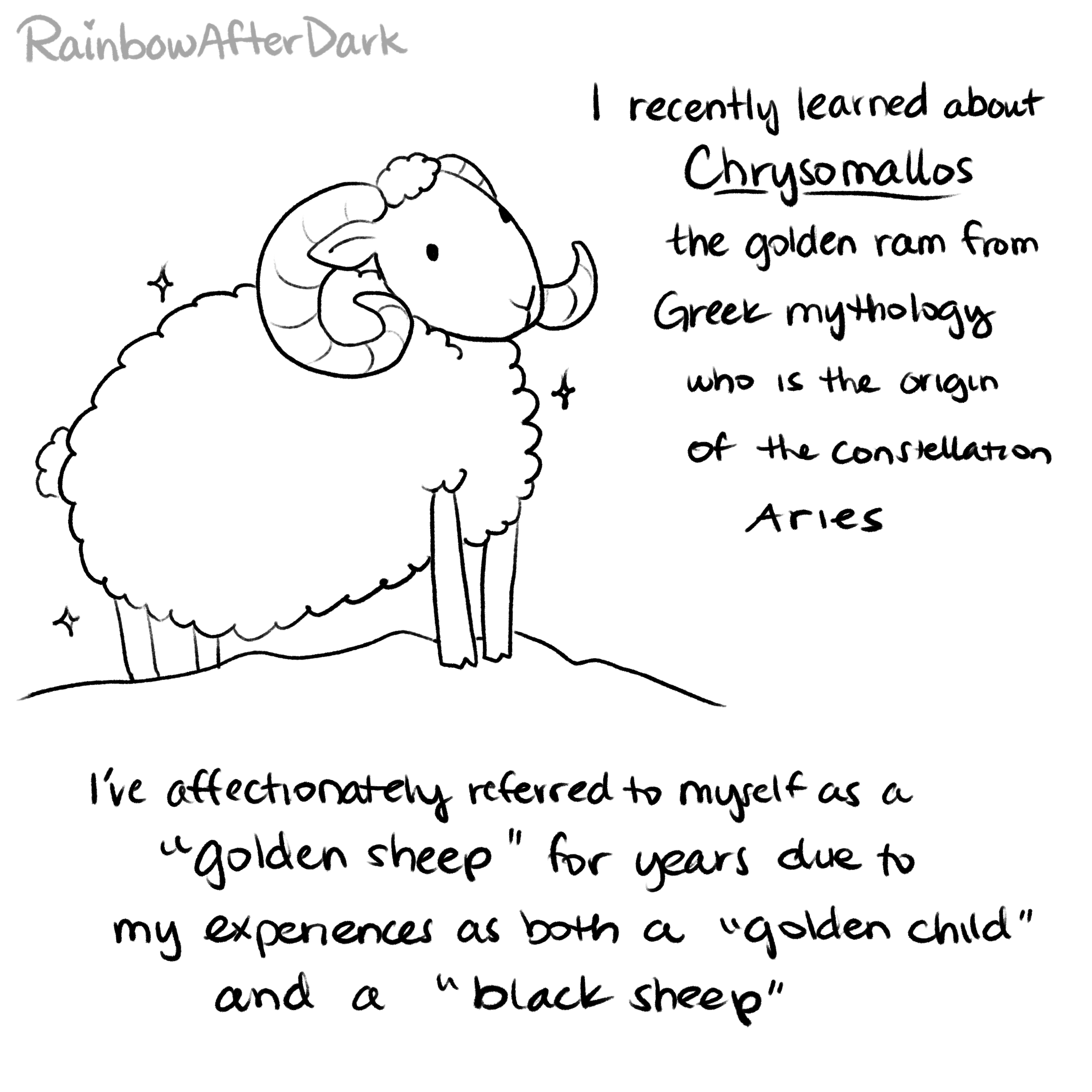
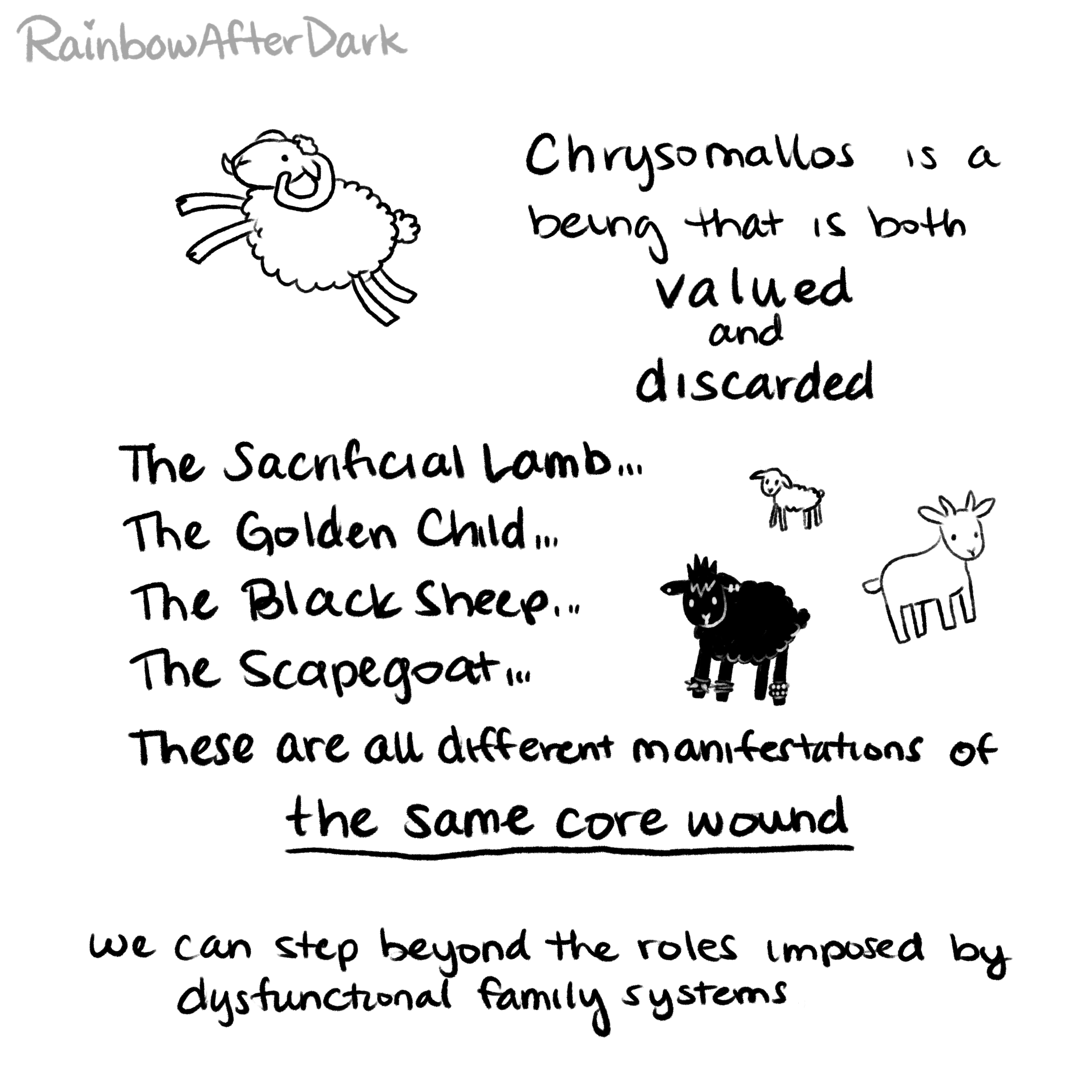
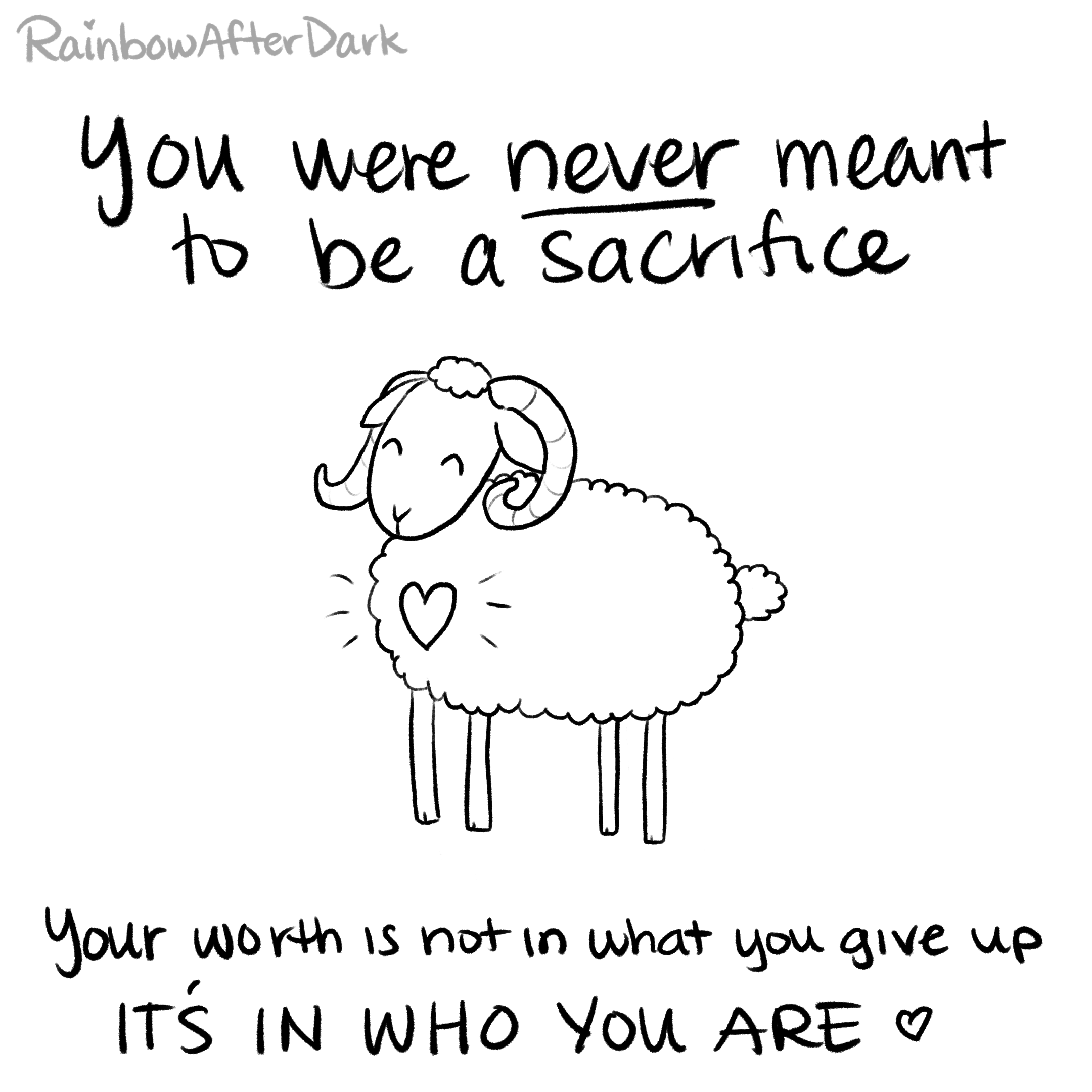
Popcyclical
Whisper into the void with me: https://rainbowafterdark.micro.blog
Podcast is on an indefinite hiatus There may be future episodes, there may not! Thank you for listening!
Healing isn’t linear—it’s messy, cyclical, paradoxical, and often feels like we’re back where we started. But what if we’re actually spiraling forward? In this episode of Rainbow After Dark, we explore the nature of cycles—how they show up in nature, our bodies, and our healing journeys. From the moon’s phases to the rewiring of old patterns, we’ll dive into why we revisit wounds, how our bodies process healing on their own timeline, and why self-compassion is essential when it feels like we’re ‘going in circles.’ Because sometimes, moving through is the only way forward.
Thanks for listening to Rainbow After Dark! If you enjoyed this episode, be sure to subscribe so you don’t miss future ones. If something resonated with you, I’d love to hear your thoughts—feel free to leave a comment here, or on YouTube (I don’t use it much, but I exist!).
This podcast is a space for reflection and exploration—it is not a substitute for professional advice. Please take care of yourself and seek support as needed.
———
Transcript for Episode 4 — “Popcyclical”: Hello, hello! Welcome! If you don’t know, I’m Rainbow, and this is Rainbow After Dark.
Last time, we got friendly with the dark, and today we’re going to talk more about cycles.
When you think about cycles, what comes to mind? For me, it’s the moon—I love the moon, and I love observing the way her cycles affect me personally, as well as humans collectively, and, y’know, all the nature-y sort of stuff—the tides and all that… animals, too, there’s a lot of different animals that are affected by the moon.
Maybe you think about life cycles, or the water cycle, or a washing machine, a bicycle, something like that. Those work, too.
I feel like as humans our brains often want to operate in a fairly linear fashion, and I don’t know, y’know this could be something that we’ve conditioned ourselves to do versus something that’s actually natural to us, but when it comes to healing we sometimes seem to think that progress and healing and growth are linear, but they’re not. Even if sometimes we wish they were.
If you think about nature, cycles are everywhere: the moon’s phases, the changing of the seasons, the way water moves through the earth and the atmosphere. There’s always a rhythm, a flow, even—the way things flow, it tends to come back around. It might be different each time that it does, but it still does it.
Spring this year might not be the same as Spring last year, but it’s similar enough for us to call it Spring, right? To denote on the calendar that we have an equinox for the Springtime and the Autumn, for the Summer and the Winter. To notice the phases of the moon as it waxes and wanes and becomes full or dark for the new moon.
When it comes to healing, just like nature, it works in sort of a cyclical-cyclical pattern. I don’t know why “cyclical” is such a hard word for me to say, but here we are. We revisit old wounds in new ways. Sometimes it feels like the way we’re revisiting these things, we’re ‘back at square one,’ or we’re regressing, or we haven’t made any progress at all… but in reality, we’re moving through them differently. We’ve gathered other experiences and perspectives that, y’know, help us level up. You can insert the Mario, Super Mario noises in here again if you would like.
When we experience trauma, y’know, any kind of trauma—big T trauma, little t trauma—if it’s wounding you, it’s trauma, you know? It can become something that cycles within us. I feel like a lot of the times we’ll experience the wounds externally in cycles, but it also is-it’s an internal process, right? We will revisit these wounds, both internally and externally, but each time it’s not exactly the same. It might feel really, really familiar—especially depending on circumstances, context, various variables—but it’s never exactly the same. I like to think of it like a spiral—you keep moving forward, even if it feels like you’re returning to the same place. But you’re not. You are shifting perspectives and you’re growing. Even if it’s just, you know, like a teeny tiny little bit, right? You’ve garnered some new information each time that will allow you to keep kind of moving in an upward sort of pattern. Moving through the different layers and, I wanna say it’s like distilling the distortion in a way—you’re moving through the distortion and seeing things with an increasing amount of clarity as you do it, if, hopefully you are growth oriented and doing your best to be aware of yourself and conscious of your patterns and behaviors and things like that. The way I think that—even if it’s not something that’s kind of like, in your conscious mindset, even if someone is deeply instilled in subconscious patterns, it’s probably something that’s still happening beneath the surface. It’s just, maybe, harder to see.
You can find yourself facing old patterns, old triggers, or even emotions about things that you thought you already worked through. I know I’ve experienced this a lot where it’s like, “I thought—I thought we processed this. Like, I thought we—we did this already.” But it’s coming up with new layers and I feel like, especially when you’re really deep in the trenches of something, especially—especially—if something that you are now processing has been deeply suppressed and/or repressed, then you kind of like bring it up in little bits. But you have more information each time you do it. And sometimes too, it’ll come back up so that you can actually see that you’re not in the same space. But when you’re really deep in those trenches, especially if you’re dealing with stuff that has been really deeply embedded and really deeply repressed or suppressed… then it tends to take a lot more time and more visitations. And that can feel frustrating or discouraging, and you might feel like you’re ’back in the past’ or that you’re just doing—rehashing things over and over again… that you’re not actually making progress, or you’re even backsliding. But I feel like the key is understanding that it’s actually a part of the process.
Like I said, I’ve noticed this for my own process, my own journey. One of the biggest things has been working through abandonment wounds from childhood, and they have just—it’s something that I’ve experienced over and over again as an adult in a myriad of ways. Both through self-abandonment as well as experiences within my relationships. And all kinds relationships—a lot of the time people think about how abandonment wounds affect romantic relationships, which I’ve absolutely experienced—and I’ve also experienced it, y’know, familially, obviously, given the childhood nature of the wounding… but friendships, and just, if it’s a type of relationship you can have I have I have probably had the abandonment wounding show up in some way at some point.
So… there’s a lot of—there’s a lot of paradox in—there’s a lot of paradox in the whole healing process. It’s very cyclical, it’s nonlinear. It’s… yeah. Healing isn’t linear—it is messy, it is cyclical, it’s paradoxical. Sometimes we expect or hope for one big moment of transformation or like we’re, quote-unquote “fixing” it… but it is not like flipping a switch. At least not in my experience. It’s more like a slow rewiring process of, like, you know, the whole thing. And you can think about it like wiring a switch, too—y’know, if you have these really deeply ingrained patterns, these really, really deep wounds and you’re learning how to be in a different way? You’re learning how to operate and function in a completely new way… like it, it is a process of, like, revisiting and just unwiring and rewiring and going through all of that. And, like, if you think about how if somebody is wiring, y’know, a light switch or something… like, please forgive me, I know basically nothing about electrical—y’know, electrical stuff—but from my basic knowledge if you are to wire a light to a light switch you have to have the wires wired a certain way, otherwise, it doesn’t matter how many times you flip the switch, it’s not gonna turn on. It’s just not. And you might have to, like, move the wires around until you actually have the configuration that allows you to finally flip that switch and turn the light on. I don’t know if lights are the best example ‘cause I feel like, from the little I do know, they’re fairly, like, it’s usually just a couple of wires. But, it’s beyond me. Point is it’s a metaphor. Hopefully it makes sense to you. It’s something that’s kind of helped me to make sense of the whole process because I often felt like I should just… be… done with it or something? But you’re never—you’re never really done with it. You know? You’re always going to keep finding new layers and uncovering new information for you to integrate throughout the entire process of you being alive. And that’s just the nature of the human experience.
Healing is very—it’s a, you know, it’s—you have seasons, like anything. Like nature, you have seasons, too. You know, sometimes it’s Spring and we’re full of growth, renewal, and… you know, all the—all the beautiful life that comes with what you think of Springtime. And then other times it’s winter, and you could feel dormant or lost or you might just need to hibernate.
Through the whole process, we’re gonna have setbacks. And… sometimes we might feel like those rest periods or setbacks or when we feel like regressing… is like a “bad” sign, but sometimes it—I feel like it’s actually a sign of progress. It’s like the ebb and flow of the tides—they come in and they go out, but they always return. What seems like regression might just be part of the rhythm. We go inward, reflect, and then come back out, and we have more clarity and understanding.
I feel like this is something I’ve noticed especially in regards to my body. Because as I’ve done a lot of internal work, I’ve definitely noticed that my body is not as badly “off”—it’s not… I, you know, I still have a lot of health challenges. This is, y’know, I’ve been dealing with chronic health conditions and things like that for basically my entire life, so it’s not a thing where I expect that I’m gonna wake up one day and just have everything be… y’know, what would be considered more “normal” or like a healthy person. If I did, like, that’d be amazing. But I’m content for the most part with where I’m at in this process because I do know that there has been a lot of progress and I’m not where I was a few years ago, or several years ago. But especially recently, I’ve gone through a lot of internal healing where I’ve really worked with a lot of my emotions in a, kind of a new way, and… while overall, I do feel better, both physically and, y’know, internally on like the emotional and mental level, there have been a lot of things that have been coming up physically and it’s kind of like they want to be, sort of fully processed out. Which I feel like makes sense if you think about the way energy works and you have more subtle energy levels like you’re emotions and your thoughts, and then you also have, like, the grosser energy levels that—that’s when you have stuff that’s in the physical, like your body. And that stuff is much denser—it’s much denser energy so it moves much slower and it takes a lot more time to process and so even though sometimes it can seem a little backwards, if you’ve gone through a lot of healing on an internal level, then you might actually have old—what seem like old symptoms cropping up physically because your body is finally processing out other layers, older layers, of this same energy.
I feel like one of the biggest things for me in this process, and something that feels really just kind of key for us as humans, is that you navigate cycles—these cycles of healing with self-compassion. When you recognize that it’s okay to revisit pain and discomfort, it’s not as uncomfortable. It doesn’t mean it’s gonna be comfortable, but, y’know, it doesn’t feel quite as overwhelming. We don’t have to judge ourselves or shame ourselves for feeling like we’re ‘going in circles.’ It’s like a dance. Sometimes you go in circles when you’re dancing. Sometimes you move in different ways. There’s tension and relaxation, there’s, y’know, an ebb and flow to dancing too, right? I would like to encourage you to embrace that ebb and flow—to embrace the rhythm of your own healing, just as you would embrace the rhythm of your breath. Right?
Healing doesn’t have to be rushed. Sometimes, the best thing you can do is to slow down and embrace where you are in the cycle, even if that part of the cycle feels like you’re stuck. Something that I’ve been saying for a while is, y’know, they have, what is the saying? “Live fast and die young.” No, no. It’s “live slow and grow old.” If you so choose, right? Slow down, relax, don’t rush it. I find that for me personally if I’m rushing something, that is one of—it’s a big trigger for my nervous system. I tend to notice that it’s really dysregulating for me. So, as a general rule, unless it’s like, a life or death, really important kind of situation where I need to be rushing, you know, because it’s some sort of an emergency or something? I don’t rush. I do my best not to rush. I consciously choose to slow down. If I notice myself rushing—take a breath—you know? And I slow the heck down. So I would encourage you to do the same. If it feels right to you. All these cycles are necessary, for the whole process—it’s how you garner new insights, you learn new lessons, and that’s how you get into the depth of it. I suppose in some ways you could think of it like a drill, you know? Like you’re drilling into the depths of your human experience, and that’s… kind of a spiral sort of situation, too, right? I don’t know engineering stuff. Hopefully my metaphors for these things make sense.
At the end of the day, cycles of trauma and healing do not mean failing. It means that you’re human. And if you are here, listening to me, I’m gonna assume you’re a human. And being human means experiencing being human. Through each of these cycles, we can closer to understanding ourselves and the healing process and… coming back to ourselves.
The time you feel like you’re ‘stuck’, or like you’re revisiting old wounds, remember that it is part of the dance. It’s part of the process. Do your best to let yourself flow with it. And remember that you’re not going in circles—it’s a spiral, and you’re moving forward. You’re leveling up. Just like Super Mario.
If you feel so called, you might take a moment to journal about the cycles you’ve noticed in your own journey. Where have you seen growth? Where have you seen reoccurring patterns? What are those cycles trying to share with you? And how can you practice more compassion for yourself if you’re feeling frustrated in those cycles? If you feel like you’re engaging in patterns that just aren’t shifting, or you aren’t able to engage with in a way that is ideal? There’s something there for you to look at—at least, that’s what I think.
Thank you for being here, I will see you next time—we’ll continue to explore the dark, the light, everything in between. And until then, keep dancing with the cycles. And remember, that I love you.
Into the Dark
Whisper into the void with me: https://rainbowafterdark.micro.blog
Podcast is on an indefinite hiatus There may be future episodes, there may not! Thank you for listening!
What happens when we stop running from the dark—when we step into it, hold it, and let it hold us? In this episode, we explore the depths of darkness—not just as pain or suffering, but as a space for transformation. Through my personal reflections on trauma, identity, and healing, let’s examine how darkness can be a guide rather than something to fear. From childhood wounds and chronic pain to relationship patterns and self-abandonment, I’ll share how facing the unknown led to clarity and growth.
Healing isn’t linear—it’s messy, cyclical, and paradoxical. But in the dark, we find ourselves. Join me as we illuminate the shadows, embracing the unseen and uncovering the wisdom that waits within.
Don’t forget to give the darkness a hug, too.
Thanks for listening to Rainbow After Dark! If you enjoyed this episode, be sure to subscribe so you don’t miss future ones. If something resonated with you, I’d love to hear your thoughts—feel free to leave a comment here, or on YouTube (I don’t use it much, but I exist!).
This podcast is a space for reflection and exploration—it is not a substitute for professional advice. Please take care of yourself and seek support as needed.
———
Transcript for Episode 3 — “Into The Dark”: Hello, hello. It’s Rainbow, and today… we’re going into the dark.
I’m sure you’ve been there. When you’ve felt that shift, when you realize you’re standing on the edge of something unknown. You might be scared to step forward, but you can’t go back. The dark is uncomfortable. It’s heavy. It’s full of everything we don’t want to look at, everything we’ve buried. And it’s where healing begins.
That’s what we’re talking about today—what it means to step into the dark, to hold it—to let it hold us, to learn from it instead of running from it. And just like anything else in healing, the dark is not just about pain. It’s paradox. Because when we feel lost? That’s when we find ourselves. When we feel alone? We begin to truly understand connection.
So let’s talk about it. Let’s talk about the dark—the ways it shaped me, the ways it shapes all of us.
I’ve had a complicated relationship with darkness. For a lot of people, it’s something you avoid and on a subconscious level I was conditioned this way too, even when, ironically, I didn’t really shy away from the dark aspects of being human most of my life—I almost seemed to revel in it. But we aren’t really taught how darkness can guide us. We’re taught to fear it, to avoid it, to reject it.
In a way, that makes sense. The unknown is, well, it’s unknown. Human brains and nervous systems aren’t big fans of that. And as a human, I can understand that.
My earliest experiences with the dark weren’t exactly safe. I was adopted from birth, and from the outside, my family looked… fine, I guess? For the most part. I came from a family of seven—I have four brothers and some people even seemed to envy having a big family. They’d tell me how wonderful it must be, but, y’know, people have their own perceptions of what a family like mine must be like. In one of my classes when I was in high school, my family issues ended up with the word “family” being embraced as “the f word”. My family was deeply dysfunctional and I consistently felt disconnected—I felt like I had to be something other than myself in order to be loved. I was usually the “good one,” “the golden child”, I was generally well-behaved—I was the one who didn’t cause problems. You know, that’s where you get perfectionism. And at the same time, I was a “black sheep”—I never belonged, I was unseen by my parents, I was ostracized by my siblings, and I felt things too deeply and saw things that nobody else wanted to talk about.
I learned early on that connection didn’t always mean being seen. Sometimes, it meant playing a role. Sometimes, it meant keeping parts of myself hidden. I felt like I had to stay in the dark to survive.
And that kind of disconnection? It does not stay in your mind. It lives in your body.
I was diagnosed with Ehlers-Danlos Syndrome in 2018–for reference, I graduated high school in 2008–but my body had been hurting for a long time before that. I’ve dealt with chronic pain since I was a teenager. I dealt with a lot of darkness when I was growing up, even before the pain started to present itself physically. I thought at one point that physical pain might actually be easier to deal with than the emotional pain I felt when I was younger, but once the physical pain became constant I was often looking to escape from myself, from my experiences… I wished I didn’t have to have a body, or that I didn’t have to exist at all.
I’m pretty sure my body has been telling the same story that my heart has—instability, unpredictability, everything falling apart at the seams. My physical pain was mirroring my emotional pain, but I didn’t have words for that. I just knew something wasn’t right.
It seemed like I didn’t need much to sustain me. I felt like I’d done a lot with neglect. But what would happen if I got what I needed to truly thrive, and not just survive? If I was nourished enough to flourish? Who could I become? What could I do? And what if everyone else was given what they needed to thrive, too?
The thing about living in the dark is that, eventually, you forget that there’s anything else. Or maybe you never knew that there was. You have to adapt. You normalize it. You don’t question it. It just becomes the way things are.
Until something happens and you are forced to see it differently.
A few years ago, I hit a turning point that made all of this painfully clear. It wasn’t the first time I realized that things needed to change, but it cracked me open in a way that nothing else had.
It was a relationship—one of many that followed a similar painful pattern. If you know, you know. You know, the kind where you’re doing everything you can to be enough, to be what they want and need, to prove that you are worthy of love. The kind where you lose yourself and don’t even realize it. Or you wonder if you ever even knew who you were to begin with.
I wanted so badly for it to work. I thought if I wanted it enough, it would just work somehow. That I could do whatever it took to make it work. But it wasn’t working—not just the relationship, but me. The way I moved through the world. The way I was being in connection. The way I ignored my own needs. The way I believed love meant sacrifice, that love meant enduring. That love meant pain.
I couldn’t run from myself anymore. I had to sit with all of this. I got to choose to sit with it—to stop looking outward—at what they or anyone else was or wasn’t doing, at what I could fix or change—and to face inward, to look inward. Into the dark.
When you’re in the dark and you see a sudden flash of light, it’s disorienting. The contrast makes shadows seem deeper and darker. Your eyes have to adjust. Maybe that’s why we resist clarity—why we resist healing. When you’ve adapted to the dark, light can feel less like illumination and more like exposure.
But once you have clarity—once you see, you can’t unsee. I mean, I guess you could try, you could pretend… but… I feel like in most cases that ends up a lot more painful than going through it. I know for me, once I really saw myself—my patterns, my fears, my pain—I couldn’t keep moving the same way.
I had to change everything.
It was terrifying. And it was liberating.
Just like a seed has to sit in darkness before it sprouts, I see the process as cyclical. Darkness is not an interruption—it’s integral. Every time I’ve needed to face uncertainty, grief, deep rest; I changed—I softened, I was restructured, I became ready for something new.
I used to think healing meant reaching a state of constant clarity. But light can be overwhelming—you give a plant too much sunlight and it burns. If you sit in the sun you can get a burn, too. If you try to come out of darkness too quickly, it’s disorienting, like when you go outside after you’ve been sitting in a dark room. Brightness can distort before it illuminates. I’ve learned to move between these states with more grace, to trust that retreating and going into my inner world doesn’t mean I’m regressing, and emerging does not mean I have all the answers.
Healing isn’t linear. It feels messy and chaotic. Sometimes it feels like you’re going in circles, but it’s a spiral, and each time you return to the dark, you’re not starting over—you’re leveling up. Like, insert Mario noises or something in here.
And healing doesn’t happen in isolation. Or, you know, it’s not meant to. It’s all in relationship, even with ourselves. But when you’ve been hurt in relationships, connection doesn’t always feel safe. It can feel really risky. It feels like the most unsafe thing you could possibly do, even if you aren’t consciously aware of it.
I’ve struggled with that a lot—the push and pull between wanting to be close to people and being afraid of what closeness could mean. Between craving connection and needing distance. Between loving people and not knowing if I could trust them. Not knowing if I could trust myself.
For most of my life, I didn’t even realize I was struggling with this. I just thought I was anxious. Traumatized. I couldn’t see the depths of it when I already felt like I was in over my head. Sometimes it felt like I was the only one who hadn’t learned how to breathe underwater.
Years ago, when I started doing shadow work, I realized just how much of that fear came from inside of me. From the parts of myself that I hadn’t faced—that I couldn’t, that I wasn’t able to face before then. Because the relationships we attract—the ones that challenge us, that hurt us, that reflect our deepest wounds—they’re mirrors. They show us what we need to see in ourselves, even if it’s painful. Especially if it’s painful. Or they can reflect our growth if we’ve taken the time to look.
And maybe that’s why we attract the people we do—not to challenge us, not just to hurt or to heal us—to help us see ourselves more clearly. To illuminate the dark and allow us to embrace our shadows.
It makes sense that I saw so much darkness when I was the light. It took me a long time to understand that. I wasn’t lost in the dark—I was illuminating it. The shadows I saw weren’t signs that I was broken; they were invitations to integrate so that I could bring the unseen into my awareness.
For a long time, I unknowingly feared darkness—not just the absence of light, but the unknown, the unknown inside myself. I thought it might swallow me whole. It meant loss, isolation, shame—it felt like a void I had to escape. But the dark doesn’t consume us and it’s not emptiness. It’s like fertile soil; seeds soften and take root, growth begins before we see it. Periods of loss and withdrawal aren’t failures—they’re phases in the cycle of growth.
Shame, though… shame told me otherwise. It told me retreating and reflecting meant something was wrong with me. That my pain and stillness proved I was unworthy and undeserving. That I was unlovable. I hid my most vulnerable parts, believing that being fully seen would lead to rejection. I feared abandonment so much that I abandoned myself. I tried to control how others saw me, and I curated the things that I shared. I was managing my emotions and trying to manage other people’s emotions too, because I didn’t want to be seen as “too much.” But control is fragile. We try to control things in an attempt to mitigate our pain. And as I tried to hold everything together, I became more fragmented. At some point, I realized that shame was actually trying to protect me, as counterintuitive and dysfunctional as it seemed.
I’ve always been sensitive—and like anyone who is sensitive, I was often getting messages, if not being told outright, that I was “too sensitive,” that I was “too much,” or, conversely, “too little.” Eventually, I leaned into sensitivity and I embraced it. Sensitivity is not weakness—it’s listening. It’s awareness. It allows for emotional attunement and for us to recognize that fear isn’t something to suppress—it’s wisdom. Fear is often protective. So is shame. It was urges us to pay attention, to tread carefully. I’ve been learning to distinguish between fear that is a warning and fear that is restricting.
Hiding parts of myself does not make them disappear. We are most controlled by what we refuse to see. What we can’t see. The stuff that’s in the dark. Shame grows in silence, but by naming it and turning toward it, I reclaimed the rejected parts. I realized that they weren’t my enemies.
That’s why the dark matters. Dark matter. Not because it’s a place to stay, but because it’s a place where we can see ourselves clearly. Where we meet the parts of ourselves that need us to acknowledge them. The parts that are scared. The parts we’ve rejected and disconnected from. The parts that have been protecting us, even when that protection has looked like self-sabotage or shutting down or staying in cycles that cause us harm. That perpetuate our pain.
The dark shows us what we need to heal. It’s a process, not a destination. And we can befriend it.
Through that—through facing ourselves, learning to hold our own shadows with compassion, maybe even giving them a little hug—we can start to build authentic connections. Connections that don’t require self-abandonment. Ones where we can show up as whole people, instead of fragments. We get to take our masks off and stop playing roles that never quite suited us anyway.
Stillness is the way to knowing. And maybe that’s why darkness has always held wisdom. It’s not so much a void, but a space. A container where the light takes form.
We spend so much of our lives trying to fight the dark. To resist pain. To force understanding. But what if we stop trying to fight it? What if, instead, we hold it? Give it a little hug?
We’re often taught that fear is something to, y’know, fear. Something to rid ourselves of. Something “bad” or “low vibrational.” That it’s “an illusion” or any number of things that encourage us to bypass it. But what if our fear loves us? What if it illuminates what we truly love? What if we could go farther by sitting with it and considering it then we ever could by dismissing or rejecting it?
Learning to befriend my fear—learning to be in companionship with the darkness—with the unknown, with my shame, with my anger, with all of it—learning to truly embrace it all instead of running from it, avoiding it, fighting it, pushing against it… that’s when I really started healing.
Healing isn’t always beautiful. It’s painful and it’s messy. You lose a lot. You learn to let go of identities, relationships, versions of yourself that you needed to survive. You figure out how to honor them and be grateful for them and also acknowledge that they might not be part of your journey anymore. It’s about allowing space for all of the parts of you, especially the parts you’ve been rejecting.
I’ve had to let go of people I loved—people I still love. I’ve had to let go of beliefs that were keeping me small. I’ve had to grieve not just what happened to me, but what didn’t happen, too—the safety I didn’t have, the childhood—the life—I didn’t get, the love I didn’t receive in the ways I needed it.
And that’s hard. And necessary. In that loss, there’s space for something new.
I used to think healing was about becoming someone new. I realize now that it’s about becoming more of who we’ve always been. We reclaim the parts of ourselves we abandoned and rejected so that we could feel accepted.
If you’re in this place right now—the space between what was and what will be—know that you’re not alone. I’m in here, too. The dark isn’t something to escape. It’s something to enter. To sit in. To move through. To learn from. To embrace—it needs a hug, too.
What would it be like to sit in the dark, to sit with fear, to sit with all the things you feel that you don’t want to feel, and really listen to what they have to say?
Wherever you are in your journey, I invite you to take a moment. Notice anything that’s stirring in you or asking to be seen. There’s no rush.
If you’re standing at the edge of the dark, uncertain and maybe a bit scared, I’d like to remind you that you’re not lost. You’re on the path. Your path. And even if you can’t see the way forward, even if everything feels uncertain, you’re where you need to be right now.
You’re not alone in the dark. You are not alone in finding your way through it. Granted, this is a whole other paradox that I’m not gonna get into right now. But it is okay to accept that that’s the way it might feel right now.
Thank you for being here. Thank you for listening. Thank you for being willing to go into the dark. Until next time—keep going. Even if “going” means sitting still. You got this. I love you.
Connecting the Dots
Whisper into the void with me: https://rainbowafterdark.micro.blog
Podcast is on an indefinite hiatus There may be future episodes, there may not! Thank you for listening!
In this episode, we’re going on a personal journey through chronic pain, illness, and the revelation that these struggles are more than just physical—they’re neurological. After being diagnosed with hypermobile Ehlers-Danlos Syndrome (EDS) at 28, I thought I had the answer, but years of persistent pain led me to a profound realization: the root of my discomfort wasn’t just my body, but my nervous system.
I explore how disconnected, survival-driven societal structures contribute to widespread nervous system dysregulation, leaving many of us stuck in a state of arrested development. I reflect on my own experiences with chronic illness, mental health diagnoses, and trauma, revealing how our nervous systems adapt to unsafe environments, often carrying invisible wounds that we can’t recognize. I’ll dive into the science of epigenetics, the link between trauma and physical health, and how this systemic disconnection can shape our biology in ways we might not expect.
This episode is an invitation to rethink how we view mental and physical health—not as isolated issues, but as interconnected expressions of the trauma and disconnection we’ve inherited. It’s a reminder that healing requires more than just a change in mindset—it calls for a deeper, body-based connection to ourselves and others. Tune in for an exploration of resilience, survival adaptations, and the urgent need for healing that goes beyond symptoms.
Thanks for listening to Rainbow After Dark! If you enjoyed this episode, be sure to subscribe so you don’t miss future ones. If something resonated with you, I’d love to hear your thoughts—feel free to leave a comment here, or on YouTube (I don’t use it much, but I exist!).
This podcast is a space for reflection and exploration—it is not a substitute for professional advice. Please take care of yourself and seek support as needed.
———
Transcript for Episode 2 — “Connecting the Dots”: Hello, fellow humans.
Since you’re here, listening to me, I’d like to tell you a story.
For nearly as long as I can remember, I’ve lived with chronic pain and illness. By the time I was a teenager, pain had become a nearly constant companion. I spent years being treated like a medical mystery—like a guinea pig, or a puzzle that no one seemed able to solve.
When I was 28 years old, I was finally diagnosed with hypermobile Ehlers-Danlos Syndrome, also known as EDS, a genetic connective tissue disorder—and I thought: this is it. I finally have the answer.
But that was only the beginning.
Fast forward to 2024, and I was in physical therapy for my shoulder pain. Again. I had spent years working on my body—building strength, stabilizing my joints, doing everything I was supposed to do.
And then I realized something: The pain I was experiencing wasn’t physiological anymore. It was neurological.
My brain hadn’t updated to recognize that I was safe. My nervous system was still responding as if I was injured—even though, logically, I knew I wasn’t.
And then, something clicked: This wasn’t just about my shoulder. This was my entire life.
The same way my body had held onto old pain, my nervous system was holding onto old fear. I was responding to connection as if it were still dangerous—even when, logically, I knew it didn’t have to be.
When I realized this, I felt two things: Frustration, because I had spent years doing all the right things—therapy, strengthening, stress management—and I was still in severe pain that was affecting my mobility. And I felt Relief, because it confirmed something that I’d been hoping: I wasn’t doing anything wrong.
And then I started to wonder: What if this isn’t just me? What if this is all of us?
We hear a lot about mental health. About trauma. We hear about depression, anxiety, loneliness.
For years, I was told my struggles were mental illness. Depression. Anxiety. PTSD. At one point, I was taking multiple psychiatric medications. But what if these weren’t just ‘chemical imbalances’ in my brain? What if they were signs that my nervous system had adapted to an unsafe world?
So maybe these aren’t just personal struggles. What if they’re symptoms of something deeper—something systemic?
We live in a world that expects people to function in ways that don’t match how humans actually develop.
There’s a concept in urban planning called desire paths. If you’ve ever seen a dirt trail cutting diagonally across a manicured lawn—one that people clearly use, even though the “official” sidewalk is somewhere else—you’ve seen a desire path.
Desire paths show us something important: people move in the ways that feel natural to them, not in the ways we design for them.
And our nervous systems are the same way.
They don’t develop according to how we think they should. They develop in response to the conditions we actually experience.
And here’s the problem: Most people never had the conditions they needed to develop a fully mature nervous system.
Western culture is built on disconnection. It values: Self-sufficiency over interdependence. Productivity over well-being. And emotional suppression over attunement.
From childhood, we’re taught to: Override our feelings. To suppress our needs. And to perform independence, even at the cost of our emotional and physical health.
We call this resilience. But really? It’s just disconnection.
When a nervous system doesn’t get what it needs to fully develop—when it never gets to experience consistent safety, attunement, and co-regulation—it adapts for survival.
That means most people are stuck in some stage of arrested development—stuck in a nervous system state that was meant to be temporary, and is now their default.
At first, I only saw this in myself—I had this unshakable feeling that something was missing. But over time, I started to see it in almost everyone.
Most of us are carrying an invisible weight we don’t have words for. And the worst part? Most of us don’t even know it.
Mental health is just as much a reflection of our nervous system’s state as our physical health. I was diagnosed with major depressive disorder at 15, PTSD at 21, and at one point I was having panic attacks every single day. Most of my life I received messages that my brain was broken. I’d done a long list of therapies including talk therapy, CBT, DBT, EMDR—basically the therapeutic alphabet. But when I realized most of my interventions had been top-down processing, I shifted gears and I started to work with my nervous system through bottom-up, body-based healing, and the more I did this, more things started to change.
Now, I rarely have panic attacks. I no longer take psychiatric medications. And I’ve gone from being housebound and relying on a caregiver to living independently. And it’s not because I ‘fixed’ my brain or my body. It’s because I learned to give myself something it had been searching for: self-connection. But self-connection doesn’t mean isolation—it meant learning to listen to myself so I could begin to build relationships that would support my nervous system.
We already know that trauma can be passed down epigenetically. Epigenetics is about the way our environment and experiences influence the expression of our genes, without altering the genetic code. Factors such as stress and trauma can impact how certain genes are turned on or off, affecting our health and behavior across generations—so generations of stress, survival-based adaptation, and relational neglect leave marks on the body—not just psychologically, but biologically.
So what if conditions like Ehlers-Danlos Syndrome, ADHD, and autism—just to name a few—aren’t just random genetic mutations?
What if they are biological adaptations to a world that has been relationally unsafe for generations?
I’ve seen this in myself in multiple ways.
For most of my life, I had severe arachnophobia. I knew spiders generally weren’t dangerous, but my body did not care. No matter how much I learned about spiders and logicked my way through it, the moment I saw one? Panic attack. My nervous system overrode everything.
This is what happens when fear becomes automatic.
And isn’t that exactly what happens with connection?
We know we need it. But if our nervous system was shaped in an environment where connection wasn’t safe? It doesn’t matter what we know—our body will still respond as if it is unsafe.
Consider that: Connective tissue is what holds our bodies together. It provides structure, flexibility, and resilience. In relationships, connection does basically the same thing—it provides emotional stability, safety, and support.
So what happens when connection itself is unstable?
Maybe the body reflects that instability.
Connective tissue disorders affect the body’s structural integrity—its ability to hold itself together. So how could we not be affected if connection and emotional attunement are missing?
Research and anecdotal evidence both suggest that there’s a strong link between connective tissue disorders like EDS and neurodivergent conditions like ADHD and autism. Many people who have hypermobile connective tissue also have differences in sensory processing, emotional regulation, and cognitive function.
I know this firsthand.
Before I was diagnosed with EDS, I recognized myself as neurodivergent. Although I was never able to access the kind of assessment that would give me a formal diagnosis, I saw myself in those traits. Over time, I’ve come to see these not as “disorders,” but as different ways of processing the world—as adaptive responses—patterns that are shaped by the environments that shaped us.
Since the origins of humanity, if people did not receive consistent attunement and connection, their nervous systems had to find ways to survive.
Some became hyper-aware—constantly scanning for danger, attuning to every shift in energy. Others adapted by tuning out—disconnecting from overwhelming experiences and stimuli.
These adaptations eventually became traits. And over time, traits became neurotypes.
We know that there’s a strong link between ADHD and autism—sometimes even called AuDHD. Many people experience a blend of these traits, rather than fitting neatly into one category. I’ve seen these patterns not just in research, but in myself.
I’ve had moments where I’m hyper-aware and deeply attuned to the smallest shifts in my environment. And I’ve had moments where I completely shut down and withdraw. These adaptations are not fixed categories.
We are not “one way” or “the other.” Our nervous systems are responding in the way that makes the most sense for the conditions they were given.
So what if ADHD’s difficulty with sustained attention is an adaptation to an environment where attunement was unpredictable? And what if autism’s deep focus and sensory sensitivities are, at least in part, a response to a world where relational safety was never guaranteed?
And what if the fluidity between these states—the shifting between hyper-awareness and shutdown—isn’t dysfunction, but a natural response to an unstable relational blueprint?
This isn’t dysfunction. This is a nervous system responding to what it was given.
Because here’s something important: our nervous systems don’t just adapt behaviorally—they adapt chemically.
From birth, the way we connect with others literally shapes our brain chemistry.
When we experience consistent, attuned connection, our brains release: Dopamine, which tells us, this is good, seek more of this. And Oxytocin which tells us, this is safe, you can relax.
But if connection is inconsistent or absent, our nervous systems adjust—they have to. Instead of dopamine reinforcing connection, we may seek it in things like hypervigilance, achievement, or external validation. Instead of oxytocin signaling safety, our bodies stay in a heightened state of alertness or withdrawal.
So whether we develop patterns of avoidance or anxiety, or both, it isn’t just psychological—it is a neurobiological imprint of what our nervous system has learned about connection.
And the nervous system doesn’t function in isolation. It’s connected to the endocrine system through what’s called the hypothalamic-pituitary-adrenal, or HPA, axis. I think I said that right. The HPA axis is a body system that controls our stress response. When we experience stress, the brain tells the adrenal glands to release hormones which help us to react to challenges. This is the system that regulates stress hormones like cortisol, which affect everything from blood sugar to immune function. Chronic stress can cause the HPA axis to become dysregulated, leading to long-term health issues.
Cortisol is our body’s primary stress hormone. It’s meant to rise in moments of danger and fall when the threat is gone. In a world without consistent connection, cortisol can stay chronically high leading to anxiety, insomnia, gut issues, chronic inflammation, and immune dysfunction.
Again, I know these effects from my own experiences. I was diagnosed with type 2 diabetes—suddenly, and without warning, like, any warning—when I was 23 years old. I wasn’t prediabetic. There was no gradual increase in blood sugar levels. At an appointment to discuss the side effects of a new antidepressant, my doctor took my blood sugar levels, and it was over 400. My A1C was above 10%. For those of you who don’t know, normal blood sugar levels are usually less than 140, and normal A1C is less than 5.7%. The strangest part? No one even told me I had diabetes. I found out when a random scheduler called to sign me up for a diabetes education class. That was how I learned my body crossed a threshold it could no longer compensate for.
We tend to think of diabetes as just a metabolic disorder—something that happens in isolation. But research shows us that chronic stress, nervous system dysregulation, and HPA axis dysfunction can directly contribute to insulin resistance. Long-term nervous system dysregulation can throw off the delicate balance of cortisol, blood sugar, and metabolism. The body stays in survival mode for so long that eventually, it starts to break down.
This is why disconnection doesn’t just affect mental health—it manifests in digestive issues, skin issues, autoimmune conditions, and chronic pain—it affects our entire body.
When connection is missing, the body knows.
If our struggles are adaptations to generations of disconnection, then healing isn’t just about managing symptoms.
It’s about creating the conditions our bodies and nervous systems have been searching for.
Because healing isn’t just about thinking differently—it’s about experiencing something different on a nervous system level.
If early connection shaped our brain chemistry, then new kinds of connection have the power to reshape it. Co-regulation—being in the presence of someone who is attuned to us—can restore the oxytocin pathways that tell us that we’re safe. Intentional connection can help rewire dopamine circuits that were hijacked by survival-based adaptations. Repatterning our nervous system through relationship allows us to create new blueprints for connection that no longer revolve around fear.
It’s not about fixing ourselves.
It’s about giving ourselves access to the kind of attunement, connection, and stability that we were always meant to have.
For some, that could mean intentional enmeshment: a consensual process of deep mutual attunement—usually temporary—designed to provide a missing imprint of safety. It’s not about losing yourself in another person; it’s about experiencing the kind of secure connection our nervous system needs.
For others, it could mean: They prioritize relationships that offer real co-regulation. We could shift how we build communities, friendships, families. And we could create a culture that values connection over performance.
We don’t just need more self-care. We need better ways of being together.
Because the truth is that we were never meant to do this alone.
So, what if we chose connection? And this isn’t just about people with formal diagnoses. This is all of us.
In a disconnected world, everyone’s nervous system is affected to some degree.
But if disconnection is learned, then connection can be re-learned.
How would your life change if you felt deeply connected—to yourself, to others, to life itself? What small changes could help you feel a little more connected right now?
Imagine a world where we don’t dismiss our longing for connection. Imagine if we didn’t expect people to override their own biology just to “fit in” or to survive.
Imagine if we designed a world not around productivity, but around how humans actually function.
A world that supports the most sensitive, most disconnected, and most overlooked—that would be a world where we all could thrive.
We heal when we finally receive the connection we were always supposed to have.
Maybe—just maybe—connection was never the problem.
Maybe it was always the answer.
Hello, I’m Rainbow
Whisper into the void with me: https://rainbowafterdark.micro.blog
Podcast is on an indefinite hiatus There may be future episodes, there may not! Thank you for listening!
Welcome to Rainbow After Dark, a place where we whisper into the void and explore the weird, messy, beautiful paradox of being human. In this first episode, I introduce myself and the purpose behind this podcast—a space to connect and embrace both the light and the dark.
I share a bit about my own journey, how chaos and contradiction have shaped me, and why connection—to ourselves, to others, and to life itself—is at the heart of what we’ll explore together. I’ll reflect on the complexities of existence, navigating disconnection, and how paradox is something we’re meant to live in (and embrace! give it a hug!) instead of solve.
This isn’t a “how-to” guide. It’s an ever evolving experiment; a space for growth, wonder, and understanding. So, whether you’re here out of curiosity, by accident, or because you’re looking for a little light in the dark—thank you for joining me.
Thanks for listening to Rainbow After Dark! If you enjoyed this episode, be sure to subscribe so you don’t miss future ones. If something resonated with you, I’d love to hear your thoughts—feel free to leave a comment here, or on YouTube (I don’t use it much, but I exist!).
This podcast is a space for reflection and exploration—it is not a substitute for professional advice. Please take care of yourself and seek support as needed.
———
Transcript for Episode 1 — “Hello, I’m Rainbow”: Hello, I’m Rainbow. I am a human on the internet—whispering into the void—and this is Rainbow After Dark. This is a space where I can move thoughts from the inside of my brain to the outside. Somewhere I can process my life out loud, and share what I’ve learned from navigating the weird, messy, beautiful paradox of being human. At its heart, this is a podcast about connection—with ourselves, with others, with life itself. So… whether you’re here out of curiosity, by accident, or because you also like whispering into the void… I’m glad you’re here. If you’ve ever found yourself caught between contradictions, questioning everything while still trying to exist? Same. And that’s what this space is for. As I said, I’m Rainbow—I am a human figuring out how to exist in this space between birth and death that we call life—in a body that, uh… I have some notes for. It’s got its own agenda. Y’know? I often feel like a lot of my existence is outside of my control. I often feel like I’m existing in the middle of a lot of chaos. Which I suppose makes sense, y’know… my childhood… was chaotic. That’s an understatement. So I’ve always kind of existed in chaos. And, uh, I know that shaped—our environments shape all of us, and I’m no exception. And just like everyone I’ve had challenges and my life has been shaped by relentless challenges, and an equally relentless drive to understand myself and the world around me. If there’s one thing I’ve always had, though? Is an insatiable need to understand myself and basically everyone and everything else—and that’s powered by some premium, organic, homegrown audacity. And that’s where Rainbow After Dark comes in. I’ve been through a lot of dark places in my life. I want a space where the hidden, shadowy, complicated bits could come out and play with the neon-bright moments of clarity. You know, you can’t have bioluminescence without the dark, right? It’s a space for late night thoughts, existential spirals, and the kind of insights that hit you at 3 AM. It’s a space to explore what it means to grow through all of it—not by erasing contradiction, but by learning to hold the contradictions. Maybe snuggle them a little bit. Give ‘em a hug. Because paradox isn’t something to solve… it’s something we live in. It’s a part of everything, and connection is everything. And I know what it’s like to feel disconnected—from myself, from others, and from life itself. I wanna explore how we lose connection, how we find it again, and what it means to truly be in relationship with ourselves and our-our reality, our existence. I wanted to create a space for me to be unfiltered and honest and to turn my spirals of reflection into something that feels tangible… and maybe a little therapeutic. I want to share my experiences in case they can help someone feel a little more connected, or more okay with the weird, messy nature of being human. This is an offering of solidarity, because if you’ve ever felt lost in the dark or like you’re failing at being human, I wan’t you to know you’re not alone. I know what it feels like to be stuck in the dark, wondering if you’re the only one trying to make sense of it all… and let’s be real, the dark gets a bad rap. It doesn’t mean it’s easy to be in a space where you can’t see forward and it feels like everything is clouded in confusion and uncertainty, but it’s also where the most growth happens, isn’t it? My hope is that I’m creating a space where you don’t have to feel alone in that. That you can see bits of your own story in mine and know that we’re all just figuring it out, together. If I can offer a little bit of light, or some sense of recognition in the chaos… then it’s worth it. No expectations, and yet… here we are. Y’know, what-what to expect? In general, I’m—you know, I wanna be honest, raw… things are probably gonna get kinda messy. They’ll probably be paradoxical. Almost certainly. Paradoxically. Healing isn’t linear. Growth does not always feel like progress. And being yourself is rarely as simple as people make it sound. I wanna talk about… Connection. The paradox of connection and disconnection—how our nervous systems adapt, both individually and collectively. Trauma, healing, embodiment… with a mixture of both science and some spirituality. We can ask existential questions, discuss duality, and the weird and wonderful ways that everything is connected. Our journey in regards to intuition, personal philosophy, an ever growing list of “ologies” that help us as humans make sense of all of this. And of course, whatever comes up organically. Because it’s all connected anyway. This space is evolving, just like I am. I do not have it all figured out. But I am here. And I’m curious. And maybe that’s enough. Maybe that’s all we need is to be here, keep asking questions, and keep exploring and growing. And ideally we can do that together. This is not a “how-to” guide, this is not expert advice, I am not here to tell anyone what to do—these are just my experiences, my observations, and whatever independent research I’ve done. It’s not polished, it’s not perfectly curated. This is a living experiment. This is an attempt to connect, and an ongoing exploration of what it means to be human. So, listen to your intuition, take what resonates, and leave the rest. If something I say sparks a different insight for you? Follow that thread. Feel free to share it with me. You know yourself better than I ever will.
Connection is one of the most fundamental human needs. But it’s also the most complicated. We crave closeness but we fear vulnerability… like, we’re terrified of it. Deer in the headlights, scared rabbit running away… like… it is something that I think most of us really, really struggle with. We long for belonging, but we resist being truly seen. We want connection—we need connection—but sometimes we’ve been taught, conditioned to feel safer when we’re isolated. And somehow we hold all of it. And it’s not just emotional, it’s biological. The nervous system, like reality itself, is built on paradox and duality. Like I said, we need connection—but if early relationships weren’t safe for us? We learn to avoid them. We long for closeness, but our bodies and our nervous systems might respond to that closeness as a threat. We can be wired for both trust, and self-protection. Because at some point, both were probably necessary. If relationships, especially early on, weren’t safe for us? We had to learn to adapt. And this is usually deeply subconscious. And sometimes we will adapt by reaching for connection. And sometimes we withdraw from it. And sometimes it can feel like both at the same time. And it’s not failure. It’s intelligence. It’s survival. Paradox isn’t just something we navigate. It’s a form of connection itself. It bridges opposites, it holds contradictions, and it reminds us that the truth—whatever that is—is rarely singular. We don’t have choose between logic and intuition, certainty and ambiguity, individuality and community. We contain all of it. And paradox threads it together. This is something I’ll explore more in future episodes—how our nervous systems adapt to disconnection, how connection and disconnection aren’t just personal struggles, but part of how we’ve adapted as individuals and as a collective. Paradox and connection are at the heart of healing. And I’m curious to explore what it means to built relationships that feel safe and expansive. If you’ve ever felt the ache of wanting connection, and also being afraid of it… the pull towards people while also wanting to push them away so you can protect yourself? You’re not broken. You’re not failing at being human. It’s not a flaw. It’s not something to fix. It’s your nervous system doing what it learned to do so you could survive. And if you’re here, and you’re listening to me? That means you did it! Great job! Give yourself a gold star, or a sticker that suits your own personal tastes. You’re living inside the same paradox as I am. And maybe part of healing is learning how to stop fighting the paradox and hold it with compassion instead. Like I said, y’know, give it a hug. Maybe healing isn’t about choosing a side… but learning to exist, and maybe even embrace the tension. That you can-you can be soft and you can be strong. You can be connected and independent. You can be safe and you can be free. And I encourage you to look at your own experiences with paradox and connection.
Next time, I’ll dive deeper into how my body and nervous system have held onto patterns of disconnection and what I have learned about healing in a world that fails to cultivate connection… and how it’s all connected. So whether you’re here to listen, whisper into the void, or join me in this weird corner of existence… thank you for being here. I hope my words spark something in you—maybe reflection, maybe connection, or maybe just a little light in the dark.